Thursday, October 15, 2015

"Since the English occupation, we have had little or no national art in Ireland at all, and there is not the slightest chance of our ever having it until we get that right of legislative independence, so unjustly robbed from us, until  we are really an Irish Nation ---  nation for whose constitutional liberty Henry Grattan lived and died. There is, however, one art which no tyranny can kill and no penal laws can stifle --- the art of poetry. An art which is one of the supreme triumphs of the race to which we belong. The poetry and music of Ireland have been not merely the luxury of the rich, but the very bulwark of patriotism, the very seed and flower of liberty."

                   --- Oscar Wilde 1882

Wednesday, October 14, 2015

Radio Rebel Gael's Salt Of The Earth


Radio Rebel Gael's YouTube Channel

  • For all those who've enjoyed listening to Radio Rebel Gael over the years, I wanted to point out that I have cancelled the Radio Rebel Gael podomatic website and service, due to what I feel are irreconcilable differences between Radio Rebel Gael and what I feel are the unscrupulous business practices of Podomatic Inc. Like most Corporate entities , Podomatic are not what they seem to be, and seem to have betrayed the very nature of podcasting and it's whole opportunity for the common people to have the freedom to broadcast FREE of cost. Podomatic seems to be more interested in joining in with the rest of the Corporate Swine to rob and pillage the general public. AS A RESULT, Radio Rebel Gael will now podcast in video format, exclusively on our new, handy dandy Radio Rebel Gael Youtube channell . Subscribe and tune in friends, fans, comrades and musicians:

 Radio Rebel Gael


Tuesday, May 26, 2015

IMPERIALISTS, BRITISH HISTORIANS & CHRISTOPHER COLUMBUS


   British historian Cecil Roth is another one of these apologists for the British Empire, who is of course, now also an apologist for the other European Imperialists, who profitted so greatly from theexploitation, mass murder , displacement, and enslavement of the indigenous peoples of the Americas, but now this British Zionist is rewriting the blood soaked legacy of Christopher Columbus as "Columbus Philanthropist & Gentle Soul", that's right folks, he is now claiming that Columbus was not a Genocidal, power trippin', racist Imperialist, but a philanthropist who gave his money to the poor, and was really a swell chap. Roth's theory is that Columbus wasn't a servant of the Crown of Spain and the main protagonist, and man that began the grim history of centuries of Conquistador-inspired genocide, slavery, mass murder, and the displacement of the indigenous peoples of the Americas, no, claims this British historian, he was really Jewish and just wanted to establish a Jewish homeland in the Americas so the Jews could escape the anti-semitism of Europe.

Now the anti-semitism and pogroms of Europe are well established, so I am not discounting those historical facts, however, these pogroms closely resemble Columbus' own treatment of the "Indians" that he encountered and I seriously do not believe in Cecil Roth's revisionism, and if you do your homework, you will discover that Columbus, , whether or not he was actually Jewish, was far from a "swell chap" or "philanthropist", and whom kept a detailed journal of his travels to the Americas, where he routinely talks about cutting off the ears of the natives, having them flogged and killed, and so forth, for "crimes" such as "stealing" a piece of fruit. Now, how the natives could actually be "stealing" the fruit that was the natural produce of their native home, well, only a British historian or racist revisionist could really come to such an unsound conclusion. Worse than that, a school of "thought" is now is pushing this idea that Columbus couldn't have been that bad because he "might have been a Jew". Only the dim witted could really go along with such garbage. It's an insult to any intelligent scholar and even more so of an insult to all of the indigenous peoples of the Americas, raped, murdered, and enslaved by the Columbus and his ilk, and the Conquistadors, that followed in his foot steps. And a man is responsible for his deeds, no matter what religion he subscribes to.

I will conclude with some details of what it was like to live as an indigenous person, when Columbus and his brothers governed Santo Domingo,, from Giles Tremlett' s "Lost document reveals Columbus as tyrant of the Caribbean" :
"Christopher Columbus, the man credited with discovering the Americas, was a greedy and vindictive tyrant who saved some of his most violent punishments for his own followers, according to a document uncovered by Spanish historians.

As governor and viceroy of the Indies, Columbus imposed iron discipline on the first Spanish colony in the Americas, in what is now the Caribbean country of Dominican Republic. Punishments included cutting off people's ears and noses, parading women naked through the streets and selling them into slavery.

"Columbus' government was characterised by a form of tyranny," Consuelo Varela, a Spanish historian who has seen the document, told journalists.
One man caught stealing corn had his nose and ears cut off, was placed in shackles and was then auctioned off as a slave. A woman who dared to suggest that Columbus was of lowly birth was punished by his brother Bartolomé, who had also travelled to the Caribbean. She was stripped naked and paraded around the colony on the back of a mule.
"Bartolomé ordered that her tongue be cut out," said Ms Varela. "Christopher congratulated him for defending the family."
"The document also describes how Columbus put down native unrest and revolt; he first ordered a brutal crackdown in which many natives were killed and then paraded their dismembered bodies through the streets in an attempt to discourage further rebellion." ("Columbus Controversy", A&E Television Networks, August 12, 2013)
Rory, Radio Rebel Gael

Sunday, May 17, 2015

"Tyrants Love Aid"


Says Malawian Professor of Political Science

James Connolly wasn't a big fan of "charity" and aid organizations, and while reading "Dark Star Safari" (P.Theroux), I came across the insightful words of Georgetown Professor of Political Science and Malawi native, Dr. Jonathan Banda, more or less echoing the same ideas regarding charity and aid (whether foreign or domestic) that were once spoken by the late James Connolly, upon his return to his native Malawi :


"...Dr. Jonathan Banda didn't get the job. He was sure the reasons for his being turned down were political. He said that if he had praised the government and the ruling party, they would have hired him.

Thinking of what the ambassador had told me, I said, 'A diplomat told me there is no political terror anymore. Is that true?'

'Maybe not , but there is political pressure of a very insidious sort.'

He seemed so outspoken I asked him the questions about charities and aid agencies that had been nagging at me. The agents of virtue in white Land Rovers ---- what were they changing?

'Not much, because all aid is political', he said. 'When this country became independent it had very few institutions. It still doesn't have many. The donors aren't contributing to development. They maintain the status quo. Politicians love that, because they hate change. The tyrants love aid. Aid helps them stay in power and contributes to underdevelopment. It's not social or cultural and it certainly isn't economic. Aid is one of the many reasons for underdevelopment in Africa.'

"You said it, I didn't", I said. "There's an awful lot of aid agencies here."

"All those vehicles, everywhere you look," he said, which is precisely what I had felt.
"So how will things change for the better?"

He said, "Change will involve all the old men dying off. Or it might take another forty years."

"What if all the donors just went away?"

"That might work."

Kind of reminds me of what Connolly says in his 1909 essay "Workshop Talks" :

"There are tens of thousands of hungry children in New York today as in every other large American city, and many well-meant efforts have been made to succour them. Free lunches have been opened in the poorest districts, bread lines have been established and charitable organisations are busy visiting homes and schools to find out the worst cases. But all this has only touched the fringe of the destitution, with the additional aggravation that anything passing through the hands of these charitable committees usually cost ten times as much for administration as it bestows on the object of its charity.....Also that the investigation is usually more effectual in destroying the last vestiges of self-respect in its victims than in succouring their needs."

People need self-empowerment, not more charity.

Wednesday, May 13, 2015

THE LIBERATOR/LIBERTADOR (2013) :


Directed by Alberto Arvelo
Not a bad film, about the legendary patriot and freedom fighter, Simón Bolívar, the only initial first reaction was, "holy smokes it's Carlos The Jackal and he stole a time machine, escaped from french prison and is hiding out from the Mossad in the jungles of South America"....haha just kidding, but seriously I had just seen this accomplished actor, Édgar Ramírez, playing that international insurgent and antizionist guerilla, Ilich Ramírez Sánchez, in the 2010 french film "Carlos", and that heavy duty image was hard to shake, but nonetheless, Ramírez plays a plausible Simón Bolívar, in this historical "epic" production.


Good way to remember an uncompromising revolutionary who fought and died for the Republic of Venezuela, years before it became a fact. And let's not forget that the film's creators were on top of their history, so the IRISH BRIGADE , that's right folks, led by Daniel O'Leary, play an integral role in the film, crossing the Andes to free Venezuela, just like they did in real history.

And just like in so many fights for national liberation, wasn't it always those most comfortable and those with the most to lose that eventually betrayed the revolution and stabbed their fellow comrades, like they did with Bolívar, in the back?! Imperialists and Slavers and Plantation owners , of course. Who else?
But a good movie despite the cheezy soundtrack. And another reminder that, in any revolutionary struggle, those closest to you, as history has proven, time and time again, are probably going to be the first to betray you. But the people, they always remember and revere the Liberators, never the betrayers. Up The Rebels. Up The Republic. Both Venezuelan and Irish.
Rory Dubhdara, Radio Rebel Gael

Monday, February 16, 2015

Gandhi Mahatma & Terence MacSwiney : Two Revolutionary Figures


(And the Misrepresentation of Gandhi to Spread Misinformation and Criminalize Liberation Movements )
-- Rory Dubhdara Radio Rebel Gael

  What really disgusts me these days, is when I hear all this hyprocrisy, spewing forth from the mouths of the same individuals who on the one hand, talk about how Gandhi is their hero, and then condemn the national liberation struggles of the Irish, the Basque, and the Palestinians, and ironically, espouse their uncondiitional support of the global terror campaigns of Britain and the USA.
  The worst form of this hypocrisy, is when I hear those who support the occupations of Iraq, Afghanistan, Palestine, the Basque country and Ireland, claiming that it's "necessary to fight terrorism" and talk out of the other side of their mouths about how "Gandhi is my hero" and how supposedly, Gandhi would have "never supported the IRA or the Intifada"
  But a careful study of Gandhi and the Indian nationalist movement, shows that not only was Gandhi an IRA sympathizer (as were many of his comrades in the Indian nationalist movement) but you will discover two undeniable facts :
Gandhi was an IRA sympathizer who like many of his fellow Indian nationalists, was inspired by men like Terence MacSwiney, whose hunger strike left an indelible impression on Gandhi and his compatriots :
 "MacSwiney's life and work had a particular impact in India. Jawaharlal Nehru took inspiration from MacSwiney's example and writings, and Mahatma Gandhi counted him among his influences.[1][2] Principles of Freedom was translated into various Indian languages including Telugu. Another Indian revolutionary Bhagat Singh was an admirer of Terence MacSwiney and wrote about him in his memoirs. While in prison during his trial he went on hunger strike to protest the conditions in which Indian revolutionaries were being kept. Bhagat Singh, in his interview with the Tribune newspaper mentioned MacSwiney as one of his inspirations. When Bhagat Singh's father petitioned the British government to pardon his son, Bhagat Singh quoted Terence MacSwiney and said "I am confident that my death will do more to smash the British Empire than my release" and told his father to withdraw the petition. He was executed on 23 March 1931, with two of his comrades, Rajguru and Sukhdev, for killing a British officer."
Sources :
1] Suruchi Thapar-Björkert, Louise Ryan. "Mother India/mother Ireland: Comparative gendered dialogues of colonialism and nationalism in the early 20th century". Women's Studies International Forum.
2]Máire MacSwiney Brugha (2006). History's Daughter: Memoir from the only child of Terence MacSwiney". O'Brien Press. 25 October 1920. Retrieved 26 August 2013.

Secondly, Gandhi had a very large segment of Indian nationalist comrades, who were not pacifists, many of whom were involved in guerrilla campaigns, in many cases, very similar to those campaigns used by the I.R.A. to oust the British occupiers.

 And all this propaganda about "terrorism" here is ironic. Ironic because amongst all this talk of "terrorism", rarely is a word said about the global campaigns of terror by the British (and the Americans) on every country and region they've occupied.
Ignorance always disgusts me, but there is nothing worse than hypocrisy. Britain used terror on every continent they occupied, from China to India to Africa to South America to Australia to Jamaica to New Zealand to North America, and attempted to wipe out the indigenous culture and the indigenous population of very country they've occupied, and continue to do so, with the help of the U.S. military in places like Iraq and Afghanistan.
   For those who who would like to read up on the terrorism perpetrated by Great Britain, far from a "civiliser" or "friend of a democracy", but a terrorist and murder machine in every nation and region that the British Armed Forces occupied, I highly recommend, Harvard Professor Caroline Elkins, "Britain's Gulag : The Brutal End of Empire in Kenya" where you can see that many of the same atrocities committed against the Irish were committed against the Kenyans. Education should always be a guide towards the truth and educators should encourage their students to question authority, question the official story on any event, and not be an intellectual coward, afraid to check sources, and truly investigate and research all segments of history. If only we had more teachers like Caroline Elkins.

Tuesday, February 10, 2015

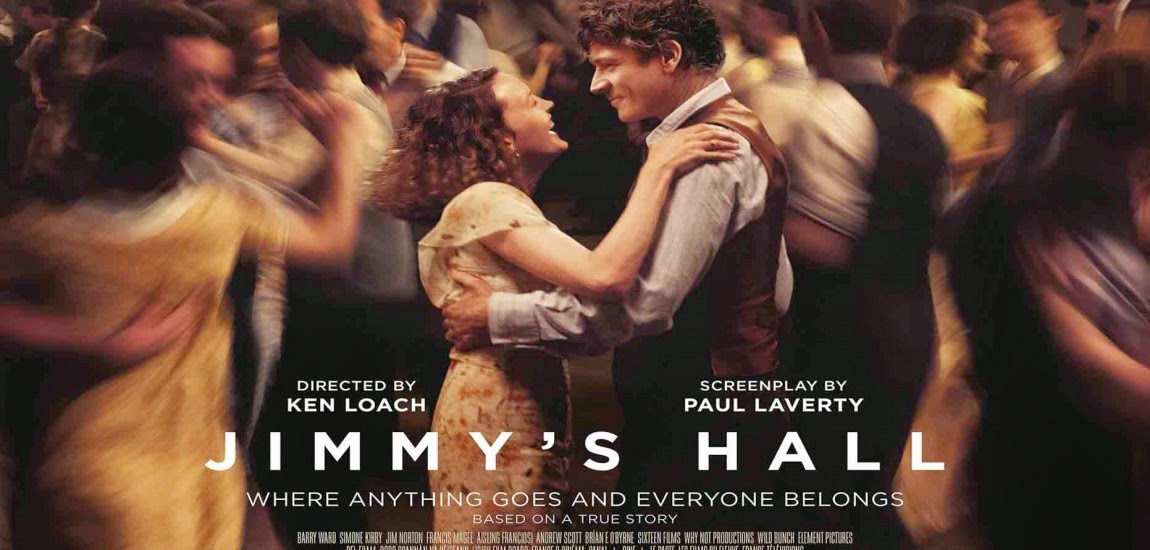
Jimmy's Hall (2014) :


If there is a must see Irish film for people of a Fenian and/or Lefist bent, than you should definitely not overlook "Jimmy's Hall, the amazing true story of Leitrim man and Rebel, James Gralton.

Based on the radical struggles and tribulations of former I.R.A. soldier and revolutionary socialist, Jimmy Gralton, whom actor Barry Ward (playing Jimmy), director Ken Loach and screenwriter Paul Laverty bring to life in a remarkable and inspirational way that could only come from the rebellious and incendiary life of such a legendary figure as James Gralton, and the brilliant writing of Paul Laverty, whom has never failed to amaze me. From "My Name's Joe" about a working class Glaswegian caught between a rock and a hard place, "Bread and Roses", about the fight for the right to unionize amongst Latin-American janitors in Los Angeles, "The Wind That Shakes the Barley" about Cork volunteers who fought in the War of Independence and the Irish Civil War,  También la lluvia (Even The Rain) about the 2000 Bolivian Water Wars of Cochabamba, as well as "The Angels' Share", the story of a troubled father from Glasgow who narrowly avoids a prison sentence and is saved by the blessed spirits of Whiskey, Laverty always roots for the underdog and tells a compelling story in the process.  But I am convinced that he has written his pièce de résistance, with "Jimmy's Hall". 

 The defiant story of this champion of the working class, James Gralton, has our protagonist battling with all the forces of corruption, greed, and tyranny in the Ireland of Éamon de Valera during the 1930's and 40's as he fights with all his strength and intellect against the local Priest, carnivorous Land Lords,  the Free State Army, the Blue Shirts, and Garda Síochána, all because he dares to take an old abandoned and decrepit building (housed on the property of his own kinsfolk) and renovate it and turn it into "Pearse-Connolly Hall" a local community center for poetry readings, dance, dance lessons, political meetings and discussions on Republican Socialism. This simple act of love for his people and giving all his efforts and knowledge towards contributing to the local poverty stricken community doesn't just inflame the Peelers, The Land Lords,  the Church and the Free State bastards, but it also needles a local faction of the Leitrim I.R.A., who just had a split, that divides the local brigade between Republican Socialists and a reactionary element of Óglaigh na hÉireann that supports the Land Lords and the wealthier business interests over the landless peasants and poor tenants. 

   This film is a real treasure, and like "The Winds That Shakes The Barley" shows how the "dissidents" are always the true heroes and celebrates those who fight for the rights of the voiceless, rather than the "rights of plunder" too often given to the Robber Barons, Quislings, Tyrants, and greedy Land Lords. 

  The main opponent of Jimmy and his Pearse-Connolly Hall, the local priest, whom while being Jimmy and his comrades chief adversary, is still able to sum up the justness of Jimmy Gralton's cause and explain why Jimmy and his comrades remain such a threat to his authority:

"You can't buy him off. He's not greedy. He's not selfish. You know they remind me of the first martyrs. Did you ever read about those union organizers in the States? The Wobblies? Entering towns and then factories, thrown into prison, lynched.."

  But like Jimmy, they never, ever, stopped fighting the good fight. 

          - Rory Dubhdara, Radio Rebel Gael 

Tuesday, January 13, 2015

THE GRAND SEDUCTION (2013) :


    This Newfie flick , directed by Don McKellar, screenplay written by Michael Dowse and Ken Scott (of "Starbuck" and "Sticky Fingers" fame) starring Brendan Gleeson, Taylor Kitsch, Liane Balaban (New Waterford Girl), Gordon Pinsent, (Made in Canada), Mark Critch (Republic of Doyle), Mary Walsh (Mambo Italiano), Cathy Jones (22 Minutes) and Matt Watts (The Newsroom), its a film that had a really strong beginning, capturing the gritty lives of many Newfoundlanders, many of whom whose families survived as fishermen for many generations and who can fish no more, due to government laws and regulations, leading to many of them having to survive on the dole, yet still lovers of good whiskey and good craic, and celtic music, both Irish and Scottish and many a rowdy shanty sing song at the local pub. The film does a brilliant job capturing that celtic spirit that is still so much of the lives of so many Newfoundlanders, and Brendan Gleeson and his fellow actors play that role so well.

    It's disappointing however, when the film takes a left turn, and becomes not a story of working class Newfies sticking together and forming a union, getting involved in a political campaign to fight for their rights as fishermen and workers, but instead, becomes a story of the unemployed natives begging and pleading for an Oil company to move to their native shores, and if that is not bad enough, instead of just setting up a clinic, they decide it will be better to trick a yuppie doctor from the city to move to their tight knit village. Not only is this a bit far fetched but doesn't really make sense and kind of shows, that not only do the writers not really understand the local dynamics of such a tight knit fishing village, but also displays a serious contempt for their community, making it seem like they are just "local yocals" who can't even fend for themselves, and of course, none of their community ever went to medical school etc.

Two things are already wrong with this picture.

    The first is how this movie, slowly but surely, becomes a 2 Hour long, Oil Company Advertisment, with the local fishermen, not fighting for their native shores and fishing rights, against the Oil Robber Barons, like Rossport Working Class Hero, Pat O'Donnell, but the opposite,they are pleading for these Oil Speculators to move to their town, despite the fact that they will inevitably contaminate their native shores and fuck off to greener shores when they are done stealing the Oil that should belong to the local people, and sucking the lifes blood from the local populace. Again, obvious contempt for the local community is on display by these screenwriters, who are just out to make a buck while insulting the working class people of Newfoundland. It's reminiscent of the old Benny Hill skits with the "drunken Paddy" and the British racist cartoons denigrating the Irish and serving to make them look less "civilized" or "cultured" as their British detractors. This movie more or less shows the same contempt for the struggling fishing communities, who really shouldn't be begging for an Oil company to move to their native shores and poison their waters after stealing the last of their natural resources, but standing up and fighting for their rights.

    Secondly, since when would any self respecting Newfie, want to learn how to play Cricket and trick a yuppie doctor from Toronto to move to Newfoundland?

Two facts remain self evident, ladies and gentlemen :

Charlie Don't Surf.

And Celts Don't Play Cricket.

-- Rory Dubhdara, Radio Rebel Gael

Wednesday, May 07, 2014

Traditional Fears


I was in a gaol, which one I did not know. Cold thick shadows and ugly walls; my boots crashed off the flags. A clerk in uniform asked questions; an officer stood by and looked at me. He spoke in a cold, thinly contemptuous voice. I disliked him thoroughly. “Come to attention when the officer speaks to you,” said the clerk. I did not move my feet or hands. “Am I to be treated as a soldier?” I asked. There was no reply. A soldier walked in front of me , a Webley in his hand, down a gloomy-looking passage. He opened the iron door of a cell, the door clanged.

The gas came through a weak jet which spluttered and gasped, lighting up slightly, now dimming the outlines of the bare walls; shadows jumped up, fell and climbed again. I sat on a few dirty, brown army blankets in a corner. I felt a sense of desolation sitting there all alone. The hard voice of the soldier who had brought me through the tall narrow passage up the clanging stairway kept coming back. “There’s your blankets.” The word “blankets” rolled in again and again as if it had untold significance. He had not answered my “Good-night.”

I was part of an automaton which spoke a regulation voice and was dehumanized. It could not attempt to assimilate so it would destroy. Outside we laughed at the British, here it was different. I felt them now as a machine; their officers could be replaced by others, a spare part efficient for a specific function would always be found. We ourselves had to depend, not on organized strength so much as on personality, understanding and intimate or intuitive knowledge.

There was always something ponderous about the British in the outward effect of their organized efficiency, parade solemnity and purpose. They were important; they took themselves seriously. The inherited class hatred of their officer type, which helped to maintain the isolation of a caste system , filtered through to the ranks of the army. Behind the mask of assurance and arrogance was another appearance; it could be seen in the uncertainty and insecurity that a movement of the people produced. Facing men of their own stamp and mentality the mask was a skin and did not change much; facing a people whom they had exploited, walked on, or laughed at, the skin became a mask. I had seen it lift. Under it was what we feel when we view aspects of our own futility in a clearly dispassionate way, aspects hidden by the outward mask which others think to be wholly strength, poise or arrogance. Fear of the unknown quantity, a spirit, uneasiness at a strength which they could not paperise in an organized roster way or hit at with organized force, and the repercussions from their own propaganda which, to show their achievements, had given us a stature in terms of their own. Their unreal summing-up of the situation cancered them and traditional bureaucracy infected them with traditional fears.


- Ernie O’Malley, “On Another Man’s Wound” , January 1921, Dublin

Tuesday, May 06, 2014

Blessed Are Those Who Hunger for Justice

Radio Rebel Gael’s Tribute to The Men of 81’


http://radiorebelgael.podomatic.com/

Featuring music by :

Padraig Mor & Sean Lyons (Glasgow)
Christy Davy & O’Faolain  (Derry)
Kelly’s Men (Derry)
Pol Mac Adaim (Belfast)
Spirit of Freedom (Tyrone)
The Irish Brigade (Tyrone)
The Druids (Kildare)
Fenian Folk (Wicklow/Waterford)
The Rebel Hearts (Tipperary)
Athenrye (Dublin)
Ray Collins (New York)
Bluestack (Chicago)
Charlie & The Bhoys (Glasgow)
Podgie (Glasgow)
Phoenix 1981 (Ireland)
Christy Moore (Kildare)
Shebeen (Glasgow)\

http://radiorebelgael.podomatic.com/

“They won’t break me because the desire for freedom, and the freedom of the Irish people, is in my heart. The day will dawn when all the people of Ireland will have the desire for freedom to show. It is then we’ll see the rising of the moon.”

                         - Bobby Sands, March 17th, 1981

Monday, March 31, 2014

Beware of the Big Black Pig

"The Black Pig of legend had shown himself. His huge bulk,  bristling spine ridges and wicked glaring eyes had been seen on dark nights beyond Elphin. People were afraid to walk the road after dark. The Black Pig had always meant trouble, sorrow and war. Around the fires I heard versions of St. Columcille's prophesies. The dark shadow of the Pig loomed through them. The Spaniard would help.....the last great battle of the Gael would be fought in the valley of the Black Pig....women would walk a day's journey without seeing a man.....

A man near Strokestown told me of the Pig. Words went away from him as he stumbled in description....'as big as a house. Man, dear and a back....God help us....I wouldn't be seen near the place for all the gold in the Bank of Ireland....take my advice, now, like a good gossoon and don't meddle with it.' He had talked to someone who had seen the Pig at the back of the schoolhouse. If I went there at midnight and called three times the Pig would appear.

I knew of the Black Pig's Dyke through successive lines of  ramparts and entrenchments that guarded the changing prehistoric boundaries of Ulster. I had seen lengths of the ramparts in different counties. The Pig had wound its way in and out of pagan and Christian belief. It meant something now, whatever it was, and though a series of debates with myself did not give any logic to my action, I was going to call it out.

One dark night I walked down towards the schoolhouse, my hobnailed boots for company in the stillness. I was nervous enough, even though I put my hand a few times to the handle of my .38, yet I felt inclined to laugh at myself for being a bigger fool than I thought I was. I was at the school, before midnight. At twelve o'clock I shouted, 'Come forth.' Silence. 'Come forth,' then a pause. I heard my own voice when it had gone away. 'Come forth,' but no ridge of spines or yellow eyes came out to frighten me."

- "On Another Man's Wound", 
March-August 1918, Ernie O'Malley

Thursday, January 16, 2014

Welcome Home, Martin Corey

Great to hear that Martin Corey has finally, after some serious campaigning on his behalf, been released and returns home. Its about time ! Especially because everyone knows his only crime was being an honest Irishman and stout Fenian !!

SMASH INTERNMENT !! 

END POLITICAL POLICING !!

Tuesday, December 31, 2013

Best of 2013 - Top Ten of Irish CD’s of 2013 :

1.) The Wakes “ The Red and The Green” :


This Glasgow Celtic Rock tour de force has become one of the best bands of the century, with the best Irish Rock since the days of The Pogues and Horslips. These Irish Glaswegians just can’t be topped. Songs of solidarity, liberation and working class harmony, The Wakes reign as one of the best bands of today, and “The Red and The Green” deserves to be rated as the best CD release of 2013, without any doubts. It wasn’t difficult to decide who should wear the Celtic Crown of 2013, and that had to go to the mighty melodious yet boisterous, and show stopping, never letting you down, and always fighting for your rights while rocking and reeling, Glasgow’s finest, The Wakes.

2.) The Rapparees “RE:SESSION” :


This 5 piece Belfast band are the latest and the greatest and they’re about to kick start a France/Germany tour in 2014, so if you get a chance to see them live, don’t miss it, they are one of the finest new Irish bands today. And I think that they have done the best version of “Outlaw Rapparee”, yet.

3.) Dropkick Murphys “Signed and Sealed In Blood” :


This Boston band really needs no introduction so I will just say that they are undeniably the best Celtic Rock band in the world with no exceptions (except for maybe, The Wakes…), and this CD just proves that they are still the world heavyweight champions of Irish Rock and Reel.


4.) Brick Top Blaggers “Two Years Enough” :


These Californian Celts are no joke, and this 2nd full length proves that they are a band that is here to stay. Their brilliant tribute to the heroes of Easter Week, 1916, “The Rising” is reason enough to check these folks out.

5.) McAlpine’s Fusiliers “When Giants Walked Our Streets” :


These Australian Celtic Rockers never cease to amaze me, and this latest creation by these Fenian Aussies is proof positive that these musicians are in a class of their own and cannot be overlooked or forgotten. Their tribute to the heroes of the legendary Fremantle Fenian prison break, “The Edge of the World” is just another reason to remember these Fenian Australians.

6.)  Derek Warfield and The Young Wolfe Tones “Let You All Be Irish Tonight” :


These legendary balladeers combine grace, grit and Gaelic melody into one amazing, incomparable Fenian masterpiece. Be sure to get a copy of this rafters roaring, singing larks a soaring, high-stepping, rebel baby.


7.)  Kevin Flynn and The Avondale Ramblers “The Broken Pavement of Avondale” :


From the streets of Chicago, comes something that you only experience, once in a lifetime, and that’s the whiskey fuelled, bar room brawling Irish-American Rockers, known as Kevin Flynn and The Avondale Ramblers, who have done it again, with another phenomenal tribute to the Celtic Spirit of working class Chicago. A must for any fan of genuine Irish Rock n’ Reel. Added bonus is guest singer, Tony Duggins, who sings with Kevin Flynn in one dynamic duo in one of my favorite tunes on this kick ass CD, “Don’t Bury Me Outside of Chicago”.

8.) Pol Mac Adaim “My Name is Troy Davis” :


Although this CD didn’t come out in 2013, it’s still one of the best and most radical folk albums of the 21st century. Pol Mac Adaim is the Joe Hill, the Woody Guthrie, the Luke Kelly, of today. Revolutionary music that comes from the heart, that can make you cry or pump your fist in anger, Pol Mac Adaim has that ability.

9.) Damien Dempsey “Almighty Love” :


This is another release that wasn’t released in 2013, coming out in the fall of 2012, and was given my Top Ten rating in 2012, but its still, in my opinion, one of the Top 10, Irish CDs of today, by a gifted pugilist, songwriter, musician and Dubliner, the unbeatable, Damien Dempsey. And you have to listen to his “Fire In the Glen”, to really understand why this musician will always be a crowd pleaser.

10.) The Tossers “ The Emerald City” :


Last but never least, goes to my favorite South Side Chicago rabble rousers., with one of their best releases to date. Get a copy folks, you won’t be disappointed. You can love them, you can hate them, but they’ll always be The Tossers, to me.


               --- Rory Dubhdara, Radio Rebel Gael


Tuesday, December 24, 2013

Feats of Strength

"Christmas, Hanukkah, Kwaanza, oh heck, Happy Festivus, haha.

While it first came to the attention of most of America by way of a television show, the celebration of a holiday called 'Festivus' is part of human history throughout the ages, most notably in ancient Rome, nineteenth-century California, and upstate New York in the 1960s.

Three basic rituals have become associated with Festivus :

First, the erecting of a Festivus pole, an unadorned length of lusterless metal or something that looks like metal, which symbolizes nothing;

Second, an Airing of Grievances that asks celebrants to take turns telling gathered friends, enemies, relatives, acquaintances and strangers in which way each has been a disppointment;

And finally, the tension-dispelling Feats of Strength, which, traditionally involve wrestling the head of the household to the floor, but has evolved to include variations such as laser-printer bench pressing, thumb-wrestling and endurance hula-hooping."


Friday, December 06, 2013

Derek Warfield & The Young Wolfe Tones “ Let Ye All Be Irish Tonight” CD:


It takes a special skill, fortitude, grace, Fenian spirit and staying power to remain as long as Derek Warfield and his Young Wolfe Tones, in the business of rousing the crowd, entertaining fans on three continents, and lifting the spirits of countless generations of Irish music enthusiasts and with the latest melodious bout of Fenian fealty, “Let Ye All Be Irish Tonight”  is yet another inspirational testament to the international love for Irish musicians like these accomplished, Young Wolfe Tones.


  There’s always something magical about listening to Irish Rebel music, it has the power to either make you cry in your beer or pump your fist into the air, depending on the mood of the melody. Beginning this 19 song Rebel opus with a cheerful sing along written by Derek Warfield and banjo maestro, Damaris Woods, the title track “Let Ye All Be Irish Tonight”, this uplifting tune reminds listeners of the global appeal of good Irish music, and that it’s not only on St. Patrick’s Day that :

“Big Herman Moser, the fat German grocer
sat down by the side of contractor McCann
While Sandy MacPherson the tall Scottish parson
Paired off with McGinty the big alderman
And Tony Moreitti who deals in spaghetti
Held hands with charming Bedelia Mc Gee
While the Swede Arthur Swanson and “English Bill” Johnson
They both strained their throats, singing ‘Mother Mo Cree’ ….”

Next, “The Three Flowers”, is a  mighty tribute to Irish heroes Theobald Wolfe Tone, Michael Dwyer and Robert Emmett, and is really turned into a buoyant dancing jig, thanks to the brilliant banjo work performed by Damaris Woods. This rousing tune reminds us of a memorable quote (printed in the in-depth and full bodied insert booklet that comes with this handsome CD) by Padraig Pearse on the power of Irish music :


“Had the Gaelic race never produced a scrap of literature, had our treasures of history and romance never had a being, had our Cormac’s, Keating’s and our O’Clery’s and Donnachadh Rua’s never written a line, these folk songs of ours would have been sufficient to prove for all time the glorious capabilities of our race.”

Wise words, indeed.

Afterwards, “Step It Out Mary”, features the stirring singing of Fintan Warfield, with a lively chorus in an unforgettable song about the dark side of arranged marriages, written by Sean McCarthy in the 1960’s, who also wrote other classics like “Highland Paddy” and “Shanagolden”. This track really resonates with me musically, with the powerful voice of Fintan Warfield, the amazing banjo backing of Damaris Woods, and Padraig McGovern’s tin whistling, and not to forget Damaris Woods brother, Jim Woods on bodhran, and Luke Wards on bass guitar boom boom, ladies and gents, please make room for another magnificent traditional reel made merry and mighty, by Derek Warfield and his Young Wolfe Tones.


   Next, 4th track on this rocking, reeling, and crooning Celtic jamboree of Fenian harmony and Rebel melodies, “Song of the Celts”, is a new tune that was written by Derek Warfield and Damaris Woods, a song that calls for Celtic solidarity across the six Celtic nations, reminding us of the shared heritage of Irish, Bretons, Scots, Manx, Welsh and Cornish, whom are all connected through our Celtic ancestry and as this mighty tune reminds us :

“There’s a blossom that’s red as the life’s blood we shed
And for Liberties cause against alien laws
When Loughgeil and O’Neill and Llanellen grew steel
For Alba and Erin and Cambria’s weal..”

Next, 5th track, “Boys of the Old Brigade”, is again given a victorious boost by Damaris Woods banjo finesse, and the uillean pipes of Padraig McGovern take us back, to raise our voices and raise the green banner of The Republic. Love the jubilant chorus that accentuates this Rebel classic.


Afterwards, “Dusty Dublin Streets Set”, is a merry medley of reels and slip jigs arranged by Damaris Woods, where yet again, her banjo prowess shines like the sunset over Tara’s halls. Traditionalists will be pleased and surprised by the bouzouki backing by Alan G. Murray, Luke Ward’s guitars. Padraig McGovern’s pipes, and Jim Woods proud percussion accompaniment in this stellar set of traditional classics.


Next, “Sweet Kitty Neil/Jimmy Ward’s Jig”, is an old harmony written by Limerick native, Francis Waller in the 19th century, and one that reminds us of the importance of dance in the Irish tradition. A tune that’s bound to cause even the most die hard of couch potato to get up and dance, only the Young Wolfe Tones could make such an old time ditty sound so relevant today. Fair play, ye Young Wolfe Tones, may your sons and daughters, carry on your proud talent and tradition.

      Afterwards, “Admiral William Brown” is a fine tribute to Foxford, Mayo native, Argentine naval hero and founder of the Argentine Navy, Admiral William Brown, whose naval genius sent the Brits running. So much of a lasting legacy was left by this proud Irish sailor, that to this day, every year,  the Argentine Navy still marches down the streets of Dublin City in commemoration.


 Next, “Mandella, The Legend”, written by Bronx native, Dan Hannon, and sung by Fintan Warfield, reminds us of Nelson Mandella’s historical  speech at Yankee stadium in the Bronx and his support for the cause of Irish Freedom. Fair play, Fintan, for some stirring singing in this legendary Rebel ballad.

Afterwards, “Boys of Fair Hill”, is an old yet memorable Cork tune that is really brought back to life by the banjo skills of Damaris Woods and the dynamic duo of crooners, Derek and Fintan Warfield, whose rousing singing will make you want to clap and sing along and maybe even after a few pints, move your feet on the dance floor. A remarkably Irish classic that the Young Wolfe Tones have truly reinvigorated with their notable talents.

Next, “Cead Mile Failte”, welcomes us home, and asks us to come in from the cold, sit down by the fire and have a cup of tea and listen to this uplifting aria of warmth and Gaelic hospitality. One hundred thousand welcomes indeed. The high spirits of the Young Wolfe Tones soars like the lark of the morning in this endearing ballad.


    Afterwards, “Paddle Your Own Canoe”, once again puts a smile on the face of even the grumpiest, and gives us the privilege to listen to the booming voice of Fintan Warfield, a tune that was written by English musician Harry Clifton in the 1800’s (whose most popular ballad of the time was his lively rendition of “Rocky Road to Dublin”, written by Galway poet, D.K. Gavan) and given wings to fly by the accomplished balladeers, the Young Wolfe Tones. I was surprised to find that this one, second only to “Step Out Mary” was one of my top picks of the album. It just makes you want to sing along, waking up your neighbors and rousing the dead.

    Next, “The Galtee Mountain Boy”, is a fine Fenian ballad about the daring exploits of Dan Breen, Sean Hogan and Sean Moylan and the part they played in the Irish War of Independence. Derek Warfield proves that he will never be too old to do what he does best, rouse his audience with another brilliant Irish Rebel anthem.


  Afterwards, “Let Mr. Maguire Sit Down” is another timeless classic that will never be forgotten, thanks to these accomplished balladeers, the Young Wolfe Tones.  A classic tune about old school Irish courtship, that is so old that its author and the exact time it was written has long since been forgotten. But from what I hear, some of the same sentiments still thrive in Ireland today :


  “Johnny get up from the fire, 
get up and give your man a seat
Don’t you know it’s Mr. Maguire and 
he is courting your sister Kate
You know very well he owns a farm a wee bit out of town
Will ye get up out of that, you impudent brat and let
Mr. Maguire sit down.”

Padraig Pearse’s legendary poem, “Oro se do Beatha Abhaile”, next thrills our hungry ears with the help of Damaris Woods mighty banjo strumming, the music keeps us all humming with a stimulating Young Wolfe Tones choir led by Derek Warfield himself. I really love this version of the timeless Fenian tune, especially with the pipes and powerful percussion, thanks to the skills of Padraig McGovern and Jim Woods.

Next, “The Dying Rebel”, written by Seamus Kavanaugh and Harry O’Donovan (and first recorded in Ireland in 1961 on the Glenside label and sung by Patricia Blake), is sung so gloriously by Fintan Warfield and the Young Wolfe Tones choir, with Damaris Woods banjo, Alan Murray’s bouzouki and Luke Ward’s guitars, making it one of the best versions of the tune that I’ve had the opportunity to listen to yet.


Afterwards, “Flower of Scotland” puts some thistle on your shamrock, reminding us of the fight for freedom that continues with our Gaelic brethren in Alba, this ballad was written in 1967 by Roy Williamson of The Corries, and although I prefer their version of this stirring anthem, the Young Wolfe Tones rendition isn’t bad. It’s unique because it combines that hillbilly banjo sound with classical accompaniment. Only a true musical genius can entertain you from highbrow to low, and its another talent that they have duly mastered.


     Next, “The Stone of Destiny Set”, gets us up off our arses to dance gaily to a boisterous traditional medley that will get you moving and grooving to Gaelic vibrations and Celtic sounds that will light a fire in your mind and a lightning bolt of clarity and wakefullness in your soul. Pure Irish bliss delivered with grace and skill by the Young Wolfe Tones. The old saying “seeing is believing” might be essential to some, but with these stout balladeers it’s instead a case of hearing, is believing. And the Young Wolfe Tones will kindle a roaring flame in your soul that will burn eternally.

Finally, “Patsy Fagan” concludes this momentous CD, with a funny lark of a song, an old time lullaby that is simple yet brilliant, written by Corkman, T.P. Keenan,  and yet another example of how the Young Wolfe Tones are blessed with the gift of sound and the gift of remembrance and keeping the memory of legendary Irish bards, balladeers, seanchai, heroes and composers, fresh in our minds. God Bless Derek Warfield and his Young Wolfe Tones, may they never cease to amaze us and delight us with their ability to keep us tuned into the eternal spirit of Ireland and all of her musical lore and legacy.


                                --- Rory Dubhdara, Radio Rebel Gael