Sunday, October 05, 2008

RADIO REBEL GAEL Paddycast # 4 - In The Heel of the Reel !!

Photobucket


The Irish-American Sound of Celtic Rebellion & Musical Mutiny !


  • Radio Rebel Gael


  • Radio Rebel Gael


  • Podcast #4 – In the Heel of the Reel – That Fenian Funky Feel !

    With all of the best Irish Rebel rhythm , Paddy Punk and Celtic Rock & Reel !

    Photobucket


    http://fenianexile.blogspot.com/


  • Radio Rebel Gael Fan Club

  • Saturday, October 04, 2008

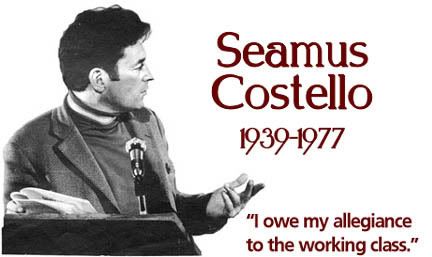
    Remember Seamus Costello, Assassinated 5 Oct 1977


    Seamus Costello — Revolutionary Socialist*


    Thanks to D. Michele Duarte and Ireland's Own !

    An Outstanding Mind and Personality in This Generation


    Seamus Costello exhibited a greatness of the same order as James Connolly. His energy, his intelligence, accuracy and thoroughness, his humour, quickness, and decisiveness, made him an outstanding mind and personality in this generation of Irishmen. He was both a thinker and a man of action, but he was also a man of deep concern and humanity based on that affectionate nature that he shared with his wife Maeliosa and children Caoilfionn, Fionan, Aoibbin, Ronan. He saw clear and far, and dared greatly. He dared to take up the unfinished task of James Connolly.
    Single-handedly, as Republicans and Socialists all around him deviated into reformism and one-sided concentration on the class or the national struggle, Seamus Costello gave clear leadership on the unity of the anti-imperialist and socialist struggle and on the need for a revolutionary approach. As Noel Browne wrote about the conference in Boston a year ago where Seamus made such an impression:


    "Seamus Costello spoke for the IRSP and gave a scintillating display of good humour, history, politics and facts.... I've never heard his brand of Republicanism before... Is it not a triumph for our radio, TV and newspapers and of the venomous Dublin political denigration machine that none of us has ever read, heard of or seen this man's remarkable dialectical skill and political ability."


    Seamus did not court the establishment that promotes shallow pretentious mediocrities like Conor Cruise O'Brien. He had the socialist vision:


    "We are nothing and we shall be everything" which the establishment recognises and fears. The establishment responded by the State conspiracy to destroy the Republican Socialist movement by torture, frame-up and perjury.


    During the tortures, as the Starry Plough front page reminded readers on the day that Seamus was murdered, Special Branch detectives made it clear that they wanted "something on that man Costello."


    The farcical trial is still dragging its repressive length along; and the same repression is now being used on the IRSP in England. Clearly Seamus Costello like James Connolly in his day was the single greatest threat to British imperialist interests in Ireland. This became clear to Noel Browne at Boston as he wrote:


    "They will have to shoot him, or to jail him, or get out of his way, but they certainly won't stop him. Costello the revolutionary Marxist Socialist whose ambition is a secular, pluralist united Socialist Republic, won't go away until he gets it."


    Owed Allegiance Only to Working Class


    Seamus's socialism was profound and practical. He came from farming background and he always championed the rights of the working farmer. The day before he was shot he was arguing at a Wicklow Agricultural meeting for the re-distribution of large ranching estates among small farmers to make their holdings viable and save them from the destruction the EEC is planning for them. He had total faith in the working class and owed allegiance only them. He spoke in the accents of the people, and the workers and small farmers of Bray and of every part of Ireland and above all the working class of Dublin knew him as one of their own. He was militantly proud of his ITGWU badge, and of his Presidency of the Bray Trades Council. His Republicanism and his Socialism were not two competing strands, but an authentic unity. He saw the interrelationship of the class and the national struggle as no-one in Ireland since Connolly had done. He thought for a while this vision could be attained by the Official Republican Movement, until he saw them abandon the anti-imperialist national struggle and turn to social reformism.


    He Fought to win not to Compromise


    He never allowed the national question to take up all his time, or warp his judgement, or make him soft on native capitalism or its political parties His life was motivated by a burning sense of justice and he seethed with indignation at the injustices and monumental stupidities of capitalist society in Ireland and on the world scale. He fought relentlessly, imperiously, against oppression of all forms of national oppression, wage-slavery, unemployment, slum housing, starvation, criminally inadequate social services.


    Like James Connolly, he was a revolutionary; which means simply that he was a fighter, relentless, intelligent, principled and skillful. He took big chances, and thoroughly utilised all resources. He fought to win, not to compromise. He could not be bought, he could not be conned and he could not be intimidated. But he economised effort, and was not unduly discouraged by setbacks, but pressed on. He was in the tradition of Fintan Lalor, who wrote:


    "Against robber-rights I will fight to their destruction or my own."


    On British Agent's Assassination List


    He was not only a political fighter. He was a great soldier. He always asserted and played his part in ensuring the right of the Irish people to use force of arms to achieve freedom from foreign domination. He could not see the British Army oppress the Irish people without attacking it decisively and tellingly.


    He fought, was wounded and interned in the '50's campaign, and he did not lay down his weapons. For years he was in the leadership of the Republican Movement He earned the respect and fear of his enemies, who put him on the British agent Littlejohn's assassination list. Like Connolly he had to a supreme degree the military virtue of courage. He lived openly and held his head high.


    A Believer in Mass Political Activity


    But he was a volunteer soldier of the people. He was not a military elitist, but a believer in the self-liberation of the Irish people by mass political activity. As a soldier of the people he was a genuine man of peace, unlike the mercenary "Peace" Movement, which exists only to encourage Irish people to be informers to their British oppressors. As he said at Crossbarry in Co. Cork in March 1976:


    "We want to build a society where our children can live in peace and prosperity, a society where they will control the wealth of this country."


    A Peacemaker


    Since his war was only against the oppressor, he was a dedicated peacemaker between anti-imperialists. At Crossbarry he said:


    "Petty differences and recriminations must be forgotten and the necessary leadership given to the Irish people. No republican or socialist can afford to allow himself to be manipulated into creating disunity in the anti-imperialist forces."


    After the assassination attempt on him at Waterford in 1975 he was asked what should be done if he were ever assassinated not by the British but by fellow-Irishmen and he answered typically:


    "No reprisals: not one death".


    He dedicated his life to anti-imperialist unity and the linking of the class and national struggles in Ireland."


    He never refused to talk with anyone in the principled pursuit of his goal. He never ceased to make strenuous efforts to reach agreement on joint action with the Officials, even though they had tried to violently suppress the IRSP, or to develop possible structures of anti-imperialist unity. But as he made clear in the first edition of the Starry Plough in April 1975 he would not consider unprincipled alliances or overtures. He criticised the current attempts at unity with Loyalists in opposing the Belfast Ring Road "We feel", he said, "that the approach to the Loyalists must be an honest one and that we must explain to them... that we are opposed to the British presence in Ireland... because we regard it as the principle means of dividing the Protestant and Catholic working class and because we regard the British presence in Ireland as the principle obstacle preventing the emergence of class politics in Ireland".


    He compared what he called "Ring Road Socialists" who try to convince people that they are not Republicans and not Socialists, with "the people in Belfast in 1913 whom Connolly described as 'gas and water socialists' ".


    On such anti-imperialist and socialist grounds he rejected the idea of an independent Ulster put forward at the Boston conference, and he maintained to the end of his life that such an imperialist solution to "he Irish question" was counter to Republican Socialism.


    International Socialist


    That Seamus Costello was an international socialist whose aim was ultimately to remove the scourge of capitalism from all the suffering people of the world is movingly expressed in the many telegrams to the IRSP from socialists the world over.


    The IRSP Will go On!


    Today we lay to rest a great Irish Republican Socialist. To know him was a privilege. To call him comrade was an honour. To be associated with him was to be inspired by his greatness, and to learn new dimensions of human possibilities.


    But the greatest lessons we have learned from our great leader are rationality and persistence. And in the spirit of Seamus Costello, his organisation will go on striking at imperialism and preparing the Irish people to take their part in the liberation of humankind.


    * This article is a slightly revised version of an article that appeared in the Starry Plough An Camchéachta August/September 2002
    ------------ --------- --------- --------- --------- --------- --------- --------- -----
    See Also:
    2003 - Bernadette Devlin McAliskey speaks on Seamus Costello
    The Legacy of Seamus Costello by Liam O Ruairc


    Friday, October 03, 2008

    Che Guevara in Ireland


    Che Guevera and Ireland


    by Mireya Castañeda, Granma International staff writer


    Two islands, Ireland and Cuba, document a virtually unknown part of Che Guevara's history.


    FEW people are aware that Ernesto Che Guevara was in Dublin in 1964. The landmarks of that year are his speech at the United Nations in New York and his journey to Algiers for the Tricontinental Conference.


    When Adys Cupull and Froilán González, Cuban researchers on Che, included a letter written by him to his father in their book Un hombre bravo (A Brave Man), some people questioned it.


    The brief letter, dated December 18, 1964, reads:


    Dear Dad:


    With the anchor dropped and the boat at a standstill, I am in this green Ireland of your ancestors. When they found out, the [Irish] television came to ask me about the Lynch genealogy, but in case they were horse thieves or something like that I didn't say much.

    Happy holidays, We're waiting for you


    Ernesto


    FROM IRELAND AT ANOTHER TIME


    Bernie Dwyer is an Irish philosophy graduate interested in women's issues and clearly a woman of her time. Thus it came as no surprise when she informed this weekly that she has always closely followed the Cuban Revolution.


    In 1988 she traveled to Havana on a solidarity brigade and, impressed by what she saw, became an active member of the solidarity movement with this other island.


    She took part in European solidarity conferences (in 1990 and 1992) and the 1st World Solidarity Conference (1994) where, as part of the Irish delegation, she met with President Fidel Castro.


    "I had a speech prepared on the two islands and imperialism," she recalls, "but when I came face to face with him I don't remember having said anything, it was Fidel himself who saw to it that we had a photo taken together." (It now hangs framed on a wall in the room where we talked here in Havana.)


    Thanks to Bernie Dwyer's solidarity, various Irish films were screened in the 1996 International Festival of New Latin American Cinema, also attended by director Jim Sheridan, who presented his film In the Name of the Father (and who we interviewed for this weekly).


    Dwyer returned to Cuba in 1998 with a Pastors for Peace Friend-shipment, and the following year at the invitation of the Union of Writers and Artists of Cuba (UNEAC).


    That was how she arrived at the home of Adys Cupull and Froilán González in the Cayo Hueso neighborhood of Havana, where they are involved in an interesting community project and, moreover, have a Che Guevara study group.


    MEANWHILE, IN CUBA


    Roberto Ruiz has always being attracted to "making" television, even in his native Guantánamo (Cuba's easternmost province) where, only at the end of the '80s, the Solvisión studios were inaugurated. Ruiz immediately worked as director of programs there and started to film documentaries, his central interest.


    As a director, he has also worked in other provinces: Holguín, Camagüey, the Isle of Youth and City of Havana (CHTV).


    He was asked to interpret for Bernie Dwyer when she was invited to appear on a TV program, and agreed. Later he accompanied her to the home of Adys and Froilán.


    Talking with an Irish woman and a documentary maker triggered Froilán's imagination, and he mentioned to them the letter from Che referring to his stopover in Dublin and the Irish stock of the Lynches.


    CHE AND THE IRISH LEGACY


    Dwyer recounted to this weekly how she and Ruiz were fired with the enthusiasm of these two academics, who have spent years researching the life and work of Comandante Che Guevara.


    "On that same visit," she said, "I was able to talk to Aleida March, Che's widow and the executor of all his papers. She only recalled a stopover in Shannon on his journey from New York to Algeria."


    Nevertheless, with the letter to his "Dear Dad" on her mind, on returning to Ireland Dwyer began her own investigations and, in Dublin's National Library, found three newspapers, The Evening Press, The Irish Independent and the The Irish Times, dated December 19, 1964, all of which covered Che's presence in Dublin.


    Naturally, Che Guevara's presence wasn't passed over by the Irish press. During the 60 minutes that the then minister of industry, age 36, spent in Dublin airport, he gave several interviews, among them one for the nascent Irish television, and spoke of the Lynches, his Irish ancestors.
    It's funny the way things happen. Bad weather that day prevented the stopover in Shannon and the aircraft landed in Dublin.


    In addition to the photocopies of those dailies, Dwyer discovered one and a half minutes of TV footage. But this researcher went further.


    In one of the photos in the press, Comandante Guevara appears with an Aer Lingus stewardess, Felima Archer, the improvised interpreter. Dwyer met with the stewardess, who still has the original photo.


    "After 35 years, she still remembers Che's eyes, his look, and that he was very relaxed, calm and happy."


    With all her precious historical material, Dwyer returned to Havana and, for her and Ruiz, the idea of a documentary was not far from their thoughts.


    Thus they began to prepare Che, legado irlandés (Che, the Irish Legacy). "We didn't want an experimental documentary, as the important thing for us was the content," Ruiz explained, "so we decided on a simple structure. It's a 10-minute documentary in which we tell this unknown story of Che in Dublin."


    The documentary covers the research, the documents they had recovered, photos of the family, interviews with Cupull and González and the Irish television footage, all with a soundtrack of Irish music.


    They explained that they also included pictures of Irish patriots, as Che's father, Ernesto Guevara Lynch, mentioned at times that Che "had rebel Irish blood."


    HIS IRISH ANCESTORS


    In Havana, Dwyer met with Ana María Erra, the widow of Che's father, who showed her a letter dated 1929, signed by Augusta Lynch and inquiring about his family's Irish history.


    Dwyer's research into archives in Dublin confirmed that the Lynch family originated in County Galway and, with a complete genealogical tree, she, Ruiz and Rosa Tanya of CHTV have made a second, five-minute documentary, Las raices de un mito (The Roots of a Myth).


    Patrick Lynch, founder of the Argentine branch of the Lynches, was born in Ireland in 1715. He left for Bilbao, Spain, and traveled from there to Argentina. Francisco Lynch (Che's great-grandfather) was born in 1817, and Ana Lynch (his grandmother) in 1861. Her son Ernesto Guevara Lynch (Che's father) was born in 1900, married Celia de la Serna and had five children. Ernesto was born in 1927.


    LOVER OF HUMANITY


    Dwyer and Ruiz have more ambitious plans. They know firsthand the passion of researching a life like that of Ernesto Guevara and have put together a project which is to take them to Ireland, Argentina and Bolivia.


    "We want to show the beautiful facet of Che, the family man, poet, philosopher, athlete and lover of humanity," they say.


    It was solidarity, which Che preached by his example, that made it possible for the unknown story of his stay in Dublin to come to light, as well as the documentation of his Irish ancestry.


    And, finally, Ernesto Che Guevara is "at anchor" on another island, Cuba, which he chose as his mother country for its ideals, and where another part of his genealogy began.
    See also:


    http://irelandsown.net/


    http://www.myspace.com/radiorebelgael

    Monday, September 29, 2008

    RADIO REBEL GAEL Podcast # 3 - The O.G. Show - Return of the Original Gael !

    Photobucket


    The Irish-American Voice of Celtic Rebellion & Musical Mutiny !

  • Radio Rebel Gael


  • Featuring
  • Radio Rebel Gael
  • Podcast #3 – The O.G. Show – Return of the Original Gael !

    With all of the best Irish Rebel rhythm , Paddy Punk & Celtic Rock by:

    Ciaran Murphy, Jerry Mc Cusker, Pol MacAdaim, Ray Collins, Kevin Conlon, Birmingham Six, Eire Og, The Gentlemen, The Battering Ram, The Dubliners (Ronnie Drew R.I.P.!), Damien Dempsey, Catgut Mary, Belfast Andi, Athenrye, Adelante, The Irish Brigade, Shebeen, Mc Alpine’s Fusiliers, Mutiny, The Stiff Little Fingers, and tons more !

    Photobucket

  • Radio Rebel Gael


  • http://fenianexile.blogspot.com/


  • Radio Rebel Gael Fan Club


  • http://www.myspace.com/radiorebelgael

    Friday, September 12, 2008

    RADIO REBEL GAEL

  • Radio Rebel Gael


  • RADIO REBEL GAEL Debut Podcast


    Photobucket


    Listen Up Culchies !


    With lots of brilliant music by JD & The Longfellows, The Gentlemen, Dancin' Knuckles, The Wages of Sin, Brendan Loughrey, The Killigans, Mutiny, Catgut Mary, Neck, Sharky Doyles, Cruachan, The Popes, Saint Bushmills Choir, Jerry Mc Cusker , Ray Collins and much more !

  • Radio Rebel Gael


  • http://ourmedia.org/node/452471

    http://www.myspace.com/radiorebelgael


  • Radio Rebel Gael


  • Photobucket


    http://ourmedia.org/node/452471


    http://fenianexile.blogspot.com/


  • Radio Rebel Gael


  • http://www.archive.org/details/RoryDubhdaraRadioRebelGael


  • Radio Rebel Gael
  • Wednesday, September 10, 2008

    Radio Rebel Gael will be offline for a little while

    • I am going to end using Live 365 for a server for my show, for various reason, the main reason being that I do not agree with some of the dishonest practices of Live 365, for example the company claims that "all of the money (generated from listeners and DJs who pay for subscribtions) goes to the DJ and the artists", and the sad fact is that ZERO of the money from their exorbitant, very costly, *rip off* charges for both Broadcasters (over $40 a month, and this rent is always climbing, so I am sure that it will be over $50 in a few months, and then they charge listeners too!) and an additional charge for listeners (as a broadcaster, I have to pay both listeners fees and broadcasting fees, and can't even listen to my own rockabilly show because I am not a "VIP member" (another word for "gullible sucker")...

      Furthermore, Live 365 claim that they are an "alternative to corporate controlled music" etc, while broadcasting "Radio Disney", and receiving large sums from a slew of big businesses advertizing on their server , from Walmart to E Insurance to Coca Cola to Anne Taylor (who thrive on sweat shop labor in Mexico and in other third world countries)

      And what is the worst of all, now they have advertizing for the CIA , yes the Central Intelligence Agency, every other add, yes, promoting a federal department who are known historically for taking part in the torture and murder of Victor Jara, and the assassination of democratically elected leaders like Salvador Allende, and who conspired to murder Ernesto Che Guevara Lynch, and worked with the Cuban Mafia in many botched attempts to assinate Fidel Castro, a man I have alot of respect for..

      I am going to try and switch to a Pod Cast format, which will be free to broadcast and will be free for all listeners. I don't know very much about Pod casting, and therefore it maybe a few months before I have the free time to start a new broadcast, but I might be able to broadcast again much sooner, if anyone can give me some tips on pod casting, the technical details etc. I have plenty of links about it, unfortunately, they are a bit long and written by guys that ramble on for ten pages or more, and frankly, I don't have the time to read through all of that right now , so a condensed version would be great...


      Rory, Radio Rebel Gael

      Photobucket

  • Radio Rebel Gael


  • Wednesday, May 21, 2008

    Patsy O'Hara, Irish National Liberation Army


    Date: May 21, 2008 9:58 AM


    Patsy O'Hara


    Irish
    National Liberation Army


    Patsy O'Hara
    'A determined and courageous Derryman'

    TWENTY - THREE - YEAR - OLD Patsy O'Hara from Derry city, was the former leader of the Irish National Liberation Army prisoners in the H-Blocks, and joined IRA Volunteer Raymond McCreesh on hunger-strike on March 22nd, 1981, three weeks after Bobby Sands and one week after Francis Hughes.


    Patsy O'Hara was born on July 11th, 1957 at Bishop Street in Derry City.


    His parents owned a small public house and grocery shop above which the family lived. His eldest brother, Sean Séamus, was interned in Long Kesh for almost four years. The second eldest in the family, Tony was imprisoned in the H-Blocks - throughout Patsy's hunger-strike - for five years before being released in August 1981, having served his full five - year sentence with no remission.


    In 1970, Patsy joined Fianna Eireann, drilled and trained in Celtic Park.


    Early in 1971, and though he was very young, he joined the Patrick Pearse Sinn Féin cumann in the Bogside, selling Easter lilies and newspapers. Internment, introduced in August 1971, hit the O'Hara family particularly severely with the arrest of Seán Séamus in October.


    Shortly after Seán's arrest Patsy, one night, went over to a friend's house in Southway where there were barricades. But coming out of the house, British soldiers opened fire, for no apparent reason, and shot patsy in the leg. He was only 14 years of age and spent several weeks in hospital and then several more weeks on crutches.


    Just after his 17th birthday, he was taken to the notorious interrogation centre at Ballykellly. He was interrogated for three days and then interned with three others who had been held for nine days.


    "Long Kesh had been burned the week previous ", said Patsy, "and as we flew above the camp in a British army helicopter we could see the complete devastation. When we arrived, we were given two blankets and mattresses and put into one of the cages.


    Shortly after his release in April 1975, Patsy joined the ranks of the fledging Irish Republican Socialist Party.


    He was arrested on May 14th, 1979, and was charged with possessing a hand grenade.


    In January 1980, he was sentenced to eight years in jail and went on the blanket.


    Writing shortly before the hunger-strike began, Patsy O'Hara grimly declared:
    "We stand for the freedom of the Irish nation so that future generations will enjoy the prosperity they rightly deserve, free from foreign interference, oppression and exploitation. The real criminals are the British imperialists who have thrived on the blood and sweat of generations of Irish men.


    "They have maintained control of Ireland through force of arms and there is only one way to end it. I would rather die than rot in this concrete tomb for years to come."

    Patsy O'Hara died at 11.29pm on Thursday, May 21st, 1981 on the same day as Raymond McCreesh with whom he had embarked on the hunger-strike 61 days earlier.


    Even in death his torturers would not let him rest. When O'Hara family received his remains n the early hours of the following morning, his nose had been broken and his corpse bore several burn marks inflicted after his death.


    Tuesday, May 20, 2008

    The Blanket : A Special Tribute to Brendan Hughes


    This Rock of Republicanism


    We come to say goodbye to you today
    I am so glad we did not bury you after your final journey
    It is fitting that we followed you once again through the streets
    And then said goodbye as your spirit went up in the flames
    That reignited our hearts

    Our personal Phoenix

    I did not expect the catch in throat upon seeing you
    coffin clothed with beret atop lifted by many hands and the lilt of a pipers lament
    I miss you, I missed you, and understood I think
    what those stark names etched in black
    did to you each time you paused to remember

    You carried them all in your heart so many years
    As today we carried you

    Rest in peace, my love, my friend, comrade, volunteer
    The true peace that cannot be bought


    Excerpt from Irishl♥ss Wants Truth And Peace ☮
    Date: May 20, 2008 8:39 AM
    ~SAOIRSE GO DEO!~

    Photobucket


    Anthony McIntyre • 16 May, 2008

    On the day that The Blanket shuts up shop it seems appropriate to sign off by penning a tribute to Brendan ‘The Dark’ Hughes who died three months ago to the day Brendan was a stalwart of The Blanket In those issues where his writings appeared the hits counter hit went through the roof, such was the interest in what he had to say His passing has left a vacuum in the hearts and lives of those who were his friends In the time that has elapsed since his life ended, there has been much commentary both in public and in private Many discussions of his legacy have taken place, aided in no small measure by the widely available writings and interviews he had left for people to mull over There have been suggestions that he may have bequeathed the public a record of his life in the IRA But no one has come forward with anything that would remotely resemble a testimony

    Thirty three years this month ago was the first time I met him in ‘A’ Wing of Crumlin Road Prison While his capture was a major loss for the IRA, his Lower Falls comrades in the jail were excited at the thought of him being on the wing alongside him His status was legendary ‘A’ Wing proved to be a roller coaster life for him It was there that he led a riot, during which he was badly beaten by British troops, in solidarity with the Long Kesh IRA which had burned the prison housing its volunteers He would later lead a hunger strike against a prolonged post-riot lock up And it was in ‘A’ Wing that he would learn – the news shouted through his cell door by a screw– that he had become the father of a son

    Despite a life of daring-do in which Brendan rubbed shoulders with some very heroic people including those who died during the 1981 hunger strike, it is instructive to learn that he had one solitary hero in his life, his father A widower with a large family, his father ‘Kevie’ struggled single handed to bring up his children - five sons and one daughter Times were hard but the family made it through It was from his father that Brendan developed a class-based view of the world This was reinforced by his own experience on the boats as a young seaman where he witnessed terrible poverty in the African port towns and cities his ship would pull into

    His desire to see a socialist outcome inspired him but his political shelter was in a republican structure rather than a socialist one He had little time for the organised left, viewing it as a mish-mash of sects He sought to avoid them like the plague, declining to turn up to events if they were involved in putting them together One winter evening in a deprived Manchester housing estate we were on our way out from a public meeting when one of the paper sellers tried to physically assault a member of some other sect; the target of the attack deemed guilty of some deviation which he had expressed from the floor Brendan seemed appalled I merely said to him something along the lines of ‘it’s just them, pay no heed to it’ While none of this put him off from publicly backing the socialist Eamonn McCann during an election foray it did leave him loathe to work in any organisational capacity with the left

    In the closing years of his life he achieved a life long ambition which was to visit Cuba For years adorning the walls of his small living room in Divis Tower were pictures of Che Guevera He had long been a fan of the Castro experiment ‘The revolution improved ordinary people’s lives there It was a waste of time here’ However, the facts on the ground in the country punctured his faith in the Cuban social system which he found discriminatory against Cuban citizens, reserving some hotels only for rich people from other countries Brendan refused to patronise these hotels in solidarity with the Cubans he felt were the victims of social apartheid

    Genuinely open minded and forever determined to do his own thinking he jealously guarded his independence Consequently, he was given to an innate caution when it came to ‘advice’ in case it was a Trojan horse trying to smuggle words into his mouth He was invariably dismissive of people telling him he should say this or that the next time he faced an interview ‘If it is so important say it yourself’, his usual retort It was one of his great strengths that if he needed advice he sought it but if he didn’t want it he would give short shrift to those proffering it Often the first any of his friends knew that Brendan had given an interview was when he was heard on the radio or read about in the print media

    His open mindedness left him with little time for dogma This lent to his character a suspicion of totalitarians masquerading as liberationists One Sunday afternoon saw the two of us standing in London’s Hyde Park listening to someone from the Nation of Islam at Speaker’s Corner berate the few curious enough to stop to see what the ranting was about The speaker was surrounded by acolytes who nodded their heads or loudly proclaimed ‘yes’ at anything they agreed with – which was everything the speaker roared My attitude to them was much the same as it had been to the irrelevant left of Manchester – something to find fun in for a while before going on to do something more purposeful, like attend a march in support of hunger strikers in Turkey Brendan was affected by it He felt the people at the soap box were fascists The menace they exuded made him very uneasy

    His concern at the emergence of fascistic tendencies amongst ostensible freedom fighters was also evident closer to home He remarked a number of years ago that he could see ‘paranoia’ within the Provisional leadership: ‘anybody who criticises must be condemned, there must be no debate; “we must not be questioned” We have something that is almost fascism developing out of this, and that is scary’

    The active suppression of political discussion riled Brendan and went against his natural inquisitive nature He had often encouraged open discussion in Cage 11 which along with Cage 9 regarded itself as a centre of progressive thinking in an otherwise conservative environment He and Gerry Adams had shared the first cubicle on the left to the entrance of the middle hut Adams had promoted a culture of learning which Brendan ensured continued on after his cell mate was freed

    We had debates, we had discussions, we had arguments, we had we read about the Palestinian cause, we read about the South African cause, we debated all these causes and we became politically educated, we became not just a soldier who was just a person who was able to fire a gun, but a person who was able to think before he fired a gun

    Like all cages, 11 seemed to have an abundance of books but it benefited from having no one who seemed to frown on any literature Unlike Cage 10 where prisoners on occasion were advised to keep certain books in the locker and not on the book shelf, in 11 everything was on open display One of Brendan’s favourites which he regularly revisited was The Technology of Political Control He felt then that republicans would need to grow au fait with its contents as over time the British state would become increasingly technologically sophisticated as it moved to crush republican resistance While Connolly always appeared as the icon of the republican left Brendan leaned more to Liam Mellows, again a taste he acquired from Gerry Adams

    Cage 11 was also a place where documentaries would be viewed avidly Anything remotely political would take priority on the black and white television screen that provided our lens on the wider world The Orlando Letelier murder in Washington by Chilean security services, the coup that overthrew Bhutto in Pakistan, William Hague’s address as a 16 year old to the annual Tory Party conference, the Khmer Rouge mass murder in Cambodia, the Baadar-Meinhoff kidnapping and killing of Hans Martin Schleyer, the death of former Italian Prime minister Aldo Moro at the hands of the Red Brigades, and the PLO defence of the Port of Tyre were all followed closely in Cage 11 In terms of intellectual exploration Cage 11 was in the avant garde, much of it a consequence of The Dark’s influence

    In the H-Blocks his distrust of ‘lectures from ‘on high’ grew more pronounced He disliked formal education and readily embraced the then in-vogue concepts developed by radical educationalists Paulo Freire and Ivan Illich which he saw as challenging to hierarchy Nor was he ever enamoured to the organised study groups that took place in some wings, preferring instead what he called ‘one-to-one’ informal exchanges

    Brendan carried a charisma which won him the respect of opponents as well as the admiration of friends In the prisons the screws showed him a particular deference Out for a drink in the Empire in South Belfast we bumped into a few former prison staff from the Kesh They offered to buy us a round We bought them one instead Shortly before he died he relayed an account of a former prisoner officer calling to visit him in his flat One night as we entered Liverpool British police detained Brendan for over an hour only to ask him about his experiences and request his autograph at the end of it

    Brendan Hughes was for long the leader of the blanket protest Ironically, while he is heavily associated with the imagery of the blanket man defying the power of the British state to force republican political prisoners to wear the prison uniform, the no-uniform protest was not his preferred option He felt it allowed the prison administration to confine republicans to their cells, from which their ability to create havoc within the echelons of prison management was attenuated And he had been familiar with too many republicans from earlier IRA generations who had worn prison uniform during their bouts of incarceration but who could never be criminalised as a result The prison arena was merely another battle field and Brendan like all capable military commanders assessed the matter in strategic terms He did not want to give any advantage or commanding heights to the opposition However, he could read the mood of his men and was sensitive to how the beatings and deprivation endured by them in their refusal to wear the uniform had become the mark of IRA and INLA pride

    The 1980 hunger strike of which he was the leader failed to resolve the prison issues that had given rise to it Again Brendan felt that a head on assault should be avoided and he disagreed strongly with the decision by Bobby Sands to launch a second strike While Bobby and his nine comrades who died eventually broke the British on the substance of political status Brendan concluded that it came at ‘too big a cost’

    Brendan had a deep affinity with those he served time with in the prison wings and cages built by the British for the purpose of crushing republicanism He was regularly visited by ex-prisoners and would instantly change course in the run of his day if he learned that a former prisoner needed assistance From the ceasefires one of Brendan’s big bones of contention lay in his firm belief that ex-prisoners had been abandoned by Sinn Fein The early death of the first blanket man Kieran Nugent particularly upset him


    Kieran died in 2000 They called him a ‘river rat’ because he spent his last days drinking by the river in Poleglass Why didn’t somebody in the movement not see he’d problems and help him? He was the bravest of the brave

    I was never quite sure that he was altogether right on this We publicly disagreed on the life and death of Kieran, he taking the view that more could have been done, I feeling that it was Kieran’s independence, so manifested in his ability to go it alone on as the first man on the blanket protest, which may have militated against him seeking help But Brendan remained adamant and publicly clashed with a Sinn Fein ex-prisoners body in the closing years of his life

    Brendan hailed from one of the great IRA companies in Belfast Known as ‘the Dogs’, D Company fought with the ferocity of a wolf in its war with the British Army It was soldiers with the British Army who gave Brendan his long standing nickname ‘the Dark’ British fatalities in the area were rivalled only by South Armagh, and then over a much longer period South Armagh had a land mass whereas the area covered by the Dogs, the Lower Falls, was less than a mile squared And being a warren of streets it had none of the foliage of South Armagh British squaddies dreaded the Dogs and were known to have driven through the district with religious paraphernalia adorning their vehicles in the vain hope that the IRA might not fire on them

    Yet Brendan was clinical without being ruthless On one occasion he spared the life of a British soldier he could easily have killed On another he expressed his regret at failing to arrive quickly enough at a place where Lower Falls locals had captured a young British soldier who stood crying for his mother The loss of British life on that occasion ate at Brendan who always regretted that other IRA colleagues arrived first and did what the IRA did when it captured enemy troops

    As the operations officer of the Belfast Brigade from late 1972 Brendan had prosecuted the war against the British with vigour Such was his energy that when an opportunity for escape from internment in December 1973 presented itself other Belfast Brigade figures of greater seniority opted for Brendan to go, given that he more than anyone else had the hands on experience to up the ante against the British In the six month period that he was free the Belfast Brigade bombed the Grand Central hotel, the British Army HQ in Belfast on two separate occasions The BBC was also car bombed Brendan had also set his mind to working on the bombing of Stormont in response to the Sunningdale Agreement which was the early mark 1 version of the Good Friday Agreement

    Brendan’s entire role in the IRA in the period that he was on the run, having escaped, was directed towards stopping the agreement working He realised that for it to have succeeded the IRA’s self defined national liberation struggle would have been truly reduced to the pejorative status termed recently by novelist Glenn Patterson as ‘the war of devolution with a north-south dimension’ In many ways the period helped mould his thinking and made his opposition to the Good Friday Agreement much more trenchant

    Throughout his entire political life Brendan adopted the stance of the dissident He was unshakeable in his belief that republicanism was a philosophy of dissent With his death dissenting republicanism has lost one of its great voices Quiet in tone but penetrating in logic, Brendan never failed to make his point

    There is so much that could be written about Brendan Hughes that any obituary will fall short of the mark A full blown book would be required to capture the life of this rock of republicanism He deserves no less

    Photobucket


    Source

    Sunday, May 18, 2008

    Rosemary Nelson Inquiry Disc "Lost"

    Lost" ???!? Yeah right ! Collusion is no Illusion ! The RUC/PSNI destroy evidence all the time so that their friends remain free to murder, maim and torture - Rory D. ]


    A disc containing personal information has been lost by the public inquiry team probing the loyalist murder of solicitor Rosemary Nelson.


    Investigators looking into the death of the forty year old said a police inquiry had been launched but the material was not believed to have been stolen.


    Mrs. Nelson died after a booby-trap bomb left by loyalists exploded under her car in March 1999.


    The inquiry said it deeply regretted “the serious breach of secure data handling protocols within the inquiry."

    The compact disc went missing on May 6.

    "Immediate steps have been taken to avoid any recurrence and a comprehensive review of all aspects of data handling has been initiated”, the inquiry said.


    "Given the nature of the information, it would not be appropriate to say more about the material involved."

    Northern Ireland Secretary Shaun Woodward said the government has "grave concerns about the breach of the detailed agreement it has with the Inquiry on the handling of data."

    He has ordered a review to ensure the inquiry is complying fully with procedures.


    Photobucket

    Friday, May 09, 2008

    Urgent support needed for Irish POW Noel Maguire


    Thanks, Na Claoimhte Solais !
    Date: May 9, 2008 1:53 PM

    A cairde

    We have received word of yet another setback for Noel he had applied for transfer to another jail Whitemoor Prison in Cambridgeshire (much nearer London,and to his only visitor ) he was told he was granted the transfer and also told by an Irish embassy official he'd have his application 'fast-tracked' by them. Apparently this isn't happening. He has been informed now by the prison admin people in Full Sutton that his transfer could take up to a year. He's decided to go on protest and expects to be put in solitary next week as a punishment. Nothing is happening yet but next week seems to be when it's likely to be happening. I would ask that we all take a few miniutes to write to Noel at the address Noel Maguire, HMP Full Sutton, York. YO41-IPS, England. Expressing our support and letting him know that he is in our thoughts also below are ways of expressing your disgust at the treatment of this man.


    We will keep everyone informed of developments but a thing to remember is Noel is isolated in an English jail being refused repatriation to his homeland, he is going through a really rough patch and feels he is being forced to fight back against the system that is constantly victimizing and putting him through untold mental anquish, so we must let him and those that are imprisoning him that he has some people that support him and will not stand by and let him be treated so inhumanly without a fight .


    Write to Noel and show our support

    Go raibh maith agaibh


    Another Miscarriage of Justice by

    Corrupt British System


    Noel Maguire

    At Noels Trial the Evidence against him ;

    The prosecution declared today that there was no direct evidence that any of the three defendants had planted a bomb

    Cell site information showed Maguire’s phone had been in the area of a yard in north London where the taxi used in the BBC bomb was bought.


    His thumbprints were subsequently discovered on one of the bank notes handed over for the cab.


    Repatriation

    The right to be repatriated to the country of your citizenship to serve a prison sentence on humanitarian grounds as lay down by the European Directive.


    A report by British Irish Rights Watch Committee on the Administration of Justice Irish Commission for Prisoners Overseas concluded:

    “Prisoners denied a transfer is deprived of contact with their families and their home communities, lessening their chances of successful reintegration on their release.

    However, the people who suffer most from the failure to transfer prisoners are their families, who are prevented by the long distances involved, the cost of the journey,

    And in some cases poor health, from visiting their relatives. Families visiting republican prisoners in England have sometimes arrived to find that their relative has been moved to another prison many miles away without their having been informed, a practice known as “ghosting”. Relatives have also been subjected to strip searches and been held under emergency laws when visiting their loved ones.

    The UK government has consistently put its own political agenda before any humanitarian consideration or any notion of respect for fundamental human rights where the transfer of prisoners is concerned”

    A knife attack on Noel last year by 2 inmates who have since been charged with attempted murder is an indication of the seriousness of the situation

    Noel Maguire is the last remaining Irish political prisoner still incarcerated in an English jail.

    All his co accused have been repatriated as was their rights as Irish Citizens

    Reasons Noel should be repatriated:

    • He is an Irish citizen and holds a valid Irish Passport, issued in
    Dublin

    • He easily qualifies for repatriation under the European directive,
    Which allows prisoners to be moved back to their own country to
    Serve their sentence closer to their family for purely humanitarian
    Reasons. He has not seen his children in 6 Years.


    • There was an attempt to murder Noel last year in which he received
    Serious knife wounds.

    If left alone and isolated his life would be
    Constantly under threat!

    • His physical and mental well being is in jeopardy if the Irish
    Government refuses him the right to be brought home to serve his
    Sentence in an Irish Jail

    Contact this email Politicalstatus@AOL.com

    Support Noel Maguire in his fight as an Irish Citizen to be repatriated on humanitarian ground

    Noel is a native of Co Fermanagh although he has family and children who live in Ireland he is 36


    ====================================================================================================================


    Urgent Appeal

    A cairde

    We are urging everyone, friends, members and concerned individuals to assist in our efforts to continue the pressure on the 26 County Government to Repatriate Noel Maguire from England to jails in the 26 counties as is his right.


    The names and addresses and sample letter is below so you can use the sample letter provided, reword it or write your own.


    Write or e-mail:


    Brian Lenihan

    Minister for Department of Justice, Equality and Law Reform

    Department of Justice, Equality and Law Reform
    94 St.

    Stephen's Green
    Dublin 2
    Phone: + 353 1 602-8202

    Email : pagemaster@justice.ie


    Constituency Office

    Laurel Lodge Shopping Centre
    Dublin 15
    Phone: + 353 1 822-0970


    Addresses to send letters to Contact in USA


    EMBASSY OF IRELAND, WASHINGTON DC

    ADDRESS:
    Embassy of Ireland
    2234 Massachusetts Ave.

    NW
    Washington, DC 20008

    TELEPHONE:
    (202) 462 3939

    FAX:
    (202) 232 5993

    ==============================================================

    CONSULATE GENERAL, NEW YORK

    ADDRESS:
    Consulate General of Ireland
    Ireland House
    345 Park Avenue
    17th Floor
    New York NY 10154-0037

    TELEPHONE:
    General Information - (212) 319 2555

    FAX:
    Consulate : - (212) 980 9475

    E- MAIL:
    congenny@AOL.com


    ==============================================================
    CONSULATE GENERAL, CHICAGO
    ADDRESS:
    Consulate General of Ireland
    400 N.

    Michigan Avenue, Suite 911
    Chicago, IL 60611

    TELEPHONE:
    (312) 337.

    1868

    FAX:
    (312) 337 1954

    E- MAIL:
    irishconsulate@sbcglobal.net

    ==============================================================

    CONSULATE GENERAL, SAN FRANCISCO

    ADDRESS:
    Consulate General of Ireland
    100 Pine St.

    , 33rd Floor
    San Francisco, CA 94111

    TELEPHONE:
    (415) 392 4214

    FAX:
    (415) 392 0885

    E- MAIL:
    irishcgsf@earthlink.net


    ==============================================================

    CONSULATE GENERAL OF IRELAND, BOSTON

    ADDRESS:
    Consulate General of Ireland
    535 Boylston Street
    Boston, MA 02116

    TELEPHONE:
    (617) 267 9330

    FAX:
    (617) 267 6375

    E- MAIL:
    irlcons@aol.com

    ==============================================================
    Sample letter


    Dear Sir

    I write to you on behalf of the Noel Maguire as it concerns his repatriation back to Ireland from a British jail and your refusal to accept Noels application thus seemingly stripping him of his Irish Citizenship and the civil rights that are associated with it.


    It is unconscionable that the Irish government continues to refuse to repatriate Noel. It is claimed that he has no close relatives living in the 26 counties, this is untrue as Noel's wife and their two children in fact live within an hour’s drive of Portlaoise Prison in Co Laois and are willing to visit him should he be repatriated. He also has two sisters and a brother in Ireland.


    Noel Maguire - who is from Co Fermanagh but hold a valid 26 County passport more than qualifies for repatriation on the grounds of the European Directive as an Irish National.


    His mental and physical health must be close to breaking point with the way he is being unfairly treated these continued delays which are tantamount to psychological torture.


    On humanitarian grounds I ask that the decision to refuse repatriation be reconsidered and he can return home to serve his sentence and be closer to his family.


    Please act now!

    Thank you.


    Is mise Le meas

    "Your Name"

    Wednesday, May 07, 2008

    The 5th of May (from the Pensive Quill)

    Go raibh maith agat, a TJ.

    Aontaim leat a chara. Agus tá fáilte romhat.

    The 5th of May is a solemn occasion in the republican calendar. Few republicans young or old would fail to instantly recognise it as the dateon which the leader of the H Blocks IRA, Bobby Sands, lost his life aftera 66 day hunger strike against the degenerate policies of a malign andmurderous British government. Those 66 days came back-to-back on a thousand plus days spent naked, locked in a cell as punishment forrefusing to wear prison uniform because to do so would have legitimised British state terror and criminalised republican opposition to it.

    In the protest blocks brutality, every bit as much as boredom, was the tireless adversary endlessly gnawing away at the will to resist. The boredom Bobby Sands fought through prolific writing, and while he couldnever hope to halt it he also used his pen to highlight the brutality.

    Apart from being, in the words of the late Denis Faul, the greatest prisonreformer of the last century, he was also one of the great bulwarks against censorship, flouting it with a pen refill and cigarette papers which he had to conceal inside a body cavity to foil the censors.

    The lengths to which punitive vindictive thugs at all levels of the British penal administration exercised their minds in the search for new ways to inflict deprivation, has long forced me to ponder on what Hanna Arendt termed "the banality of evil."
    Shortly before he died Bobby wrote:

    There is a certain screw here who has taken it upon himself to harass me to the very end and in a very vindictive childish manner. It does not worry me, the harassment, but his attitude aggravates me occasionally. It is one thing to torture, but quite a different thing to exact enjoyment from it, that's his type.

    That somebody as non-banal and prodigious in mind as this gifted and talented IRA leader should die surrounded by so many uniformed morons whose sole intellectual challenge consisted of agonising over whether to kick or punch a naked prisoner, is probably one of the greatest indictments of the British penal establishment in the last century.

    Throughout the years of the blanket protest Bobby Sands played a pivotal role in leading the resistance. His day to day struggle on the blanket is finely documented in the biography by Denis O' Hearn. Also meticulously covered in that book is the death agony he underwent. One of the characters in "Gil Courtermanche" characters in Gil Courtermanche brill Kigali, philosophically mused that "dying was simply one of the things you did one day." Death on hunger strike was much less simple. Dying was not something to be done one day. In the case of Bobby Sands, the dying lasted for over two months. The narrative detailing the pain-wracked and prolonged dying does not make for pleasant reading.

    Every year at this time those of us who were on the blanket protest, regardless of what political perspective we may hold today, reflect on the tremendous courage of Bobby and those who followed him to certain death.

    This was not a death that came like a thief in the night, creeping up on the unsuspecting but one that was seen from a distance and met with an unwavering eye. Margaret Thatcher who displayed a venom all of her own when it came to republican prisoners challenging her writ admitted tohaving admiration for his courage.

    Over the past three years there has been much public controversy about the hunger strike generated by the former republican prisoner Richard O'Rawe in his book Blanketmen. In spite of this, regardless of how the hunger strike was managed by the republican leadership, the fact that it evercame about was the direct consequence of an intransigent British government determined to criminalise a political armed struggle brought into being by its own criminal behaviour in the North. Had that government granted at the start of the hunger strike what it conceded at its end it is certain that the strike would never have taken place.

    Today I took my children to a local park. On the way we stopped at amonument to all republican hunger strikers who died in the struggle against the British. My wife photographed us there. As they later laughed and played in the park, the words of Bobby Sands that our revenge wouldbe the laughter of our children played back and forth though my mind. 27 years ago it was all so different. Then there was nothing but suppressed tears and a hatred so burning there seemed nothing capable of dousing it. Time may have dulled the hatred but has done nothing to diminish the awesomeness of Bobby Sands epic victory over malevolence.Photobucket
    Is mise le meas,
    Tj O Conchair
    Irish Republican Socialist Movement
    North American Coordinating Committee Member
    Prison Welfare Officer
    Larkin / Gallagher Cumann
    PO Box 901479
    Kansas City, Missouri
    64190-1479 USA
    Irish Republican Socialist Party

    The Starry Plough, newspaper of the IRSP

    Chicago Hunger Strike Commemoration Committee

    __._,_.___
    Photobucket

    May Day & The Palestinian Working Class Struggle(s)

    From: AKTIVEYTOR

    Date: May 7, 2008 9:03 AM

    On May 1 (May Day) of every year, the Palestinian working class marches in its struggle for national liberation. Today, the Palestinian working class, an integral part of the working class of the world, stands steadfast in its struggle for freedom - despite living under siege and occupation, deprived of all rights, including the right to work and the right to seek employment.


    Photobucket
    (Young Palestinian woman dragged from her home, without warning, by Israeli troops, they had no warrant, and she had not committed any crime : her only crime was to be born a Palestinian on an occupied "territory". In this photo you'll notice that she is so distraught that she has urinated in her pants. But the Israeli troops don't care about this young Palestinian mother, they must punish this woman for being Palestinian ! And they call this "democracy" !! ??!! -- Rory Dubhdara)

    The entire Palestinian people are subject to a collective punishment that not only deepens poverty and creates a crisis of unemployment but also continues the policy of the Zionist forces maintaining the Palestinian working class as a reserve army of labor.


    Palestinian workers today are part of an ongoing and continuous struggle for liberation. This struggle, with Palestinian workers in the forefront, spans decades and centuries - from the factories in Haifa at the turn of the century and the early resistance to British colonialism, Palestinian workers have spurred the struggle for liberation onward. Palestinian workers in 1936 waged a historic general strike over a six-month period - the longest general strike in the world - as part of the revolt against British and Zionist colonialism.


    Photobucket


    Indeed, the Zionist movement has constantly attacked Palestinian labor and Palestinian workers, from the time of its inception. As Zionist colonialism spread in Palestine (in alliance with British colonialism) in the 1920s and 1930s, policies banning the hiring of Palestinian workers spread, at the same time that local Palestinian-owned small businesses were forced out of business by larger competitors, often Zionists - creating even more unemployment, in a deliberate attempt to impoverish and dispossess Palestinian workers in their own land. In addition, Palestinians under Jordanian rule were prevented from organizing labor unions by the Jordanian regime, and all attempts at labor organizing were ruthlessly suppressed.


    These same types of attacks continue to this day, as siege and closure are used as weapons that first target Palestinian workers. Today, unemployment is once more a mechanism used against Palestinian workers in an attempt to separate them from their homeland. There is a 70% unemployment rate among university youth, and 50,000 unemployed university graduates, and 120,000 Palestinian workers without jobs. That number reached 200,000 after 3,900 factories were shut down out of the 4,000 factories operating, due to closure and siege.


    At the same time that the oppression of Palestinian workers has always played a central role in Zionist colonialism and occupation, the Palestinian workers have always played a leading role in pushing the revolution forward and constantly building the resistance. Palestinian workers - and farmers and peasants - have always made up the main forces of the resistance, and Palestinian workers' and labor organizations have played a key role in resisting occupation. The role of the Palestinian working class in the first Intifada was key, as labor organizations and trade unions and worker-led committees played a key role in organizing and coordinating resistance and protest. General strikes and mass closures of stores and factories, among many other activities of the Intifada, were coordinated by the labor unions, with broad participation and leadership of Palestinian workers. The Palestinian labor movement has given dozens of martyrs and countless prisoners from its leadership, as Palestinian union leaders have always been targeted for assassination and imprisonment.


    Photobucket


    Within the occupied lands of 1948, the Histadrut, the Zionist so-called "trade union", played a key role as an agent of the zionist state rather than a workers' organization. The slogan of "Hebrew labor" has governed the activities of the Histadrut, which for decades excluded Palestinian and Arab workers from its membership. At its inception, the Histadrut placed as its key goal "conquering" Palestine for Jewish labor - away from Palestinian Arab labor. For years, the Histadrut collected dues from Palestinian workers while providing them with no services. When, in the Oslo period, the Histadrut finally agreed to pay the Palestinian union federation, the Palestinian General Federation of Trade Unions, some compensation for the millions upon millions of dollars taken from Palestinian workers, the Histadrut soon abandoned its promise. The Histadrut has played an integral role as a part of the structure of the racist, colonial-settler state of Israel - rather than representing workers, it represents Zionist racism, and has, in fact, been an enemy of Palestinian workers. The role of the Histadrut has reflected that of the so called "Israeli left," a so-called left that is founded on the racist principles of Zionism and finds no accomodation, solidarity or space for the liberation of Palestinian workers.


    In addition, the Palestinian trade union sector of today is corrupted. It must be rebuilt, fully and completely, on a democratic basis with full participation of all forces. Palestinian workers need a leadership and an organization that represents them and the valor and steadfastness of their struggle. In addition, the Palestinian Authority itself has deprived Palestinian workers of their rights - refusing to pay salaries and wages to many workers, including teachers, engineers and employees of the general public sector, in an attempt to exercise political control over the political activities of Palestinian workers. Indeed, the Prime Minister of the Ramallah government is none other than Salam Fayyad, a former representative of the World Bank and the International Monetary Fund. These organizations, known around the world for their anti-worker policies of forced corporatization and imposed "austerity," have, in Palestine, played the same role they have elsewhere, of fostering exploitation and imperialism. The World Bank has been key in developing a plan to create so-called "industrial zones," into which Palestinians, dispossessed of their land, would travel to work, in an environment geared toward foreign exploitation, rather than Palestinian economic development, and without trade unions or labor protection, in prison-like conditions, surrounded by the racist annexation wall.


    Similar forces of repression have been arrayed against the Arab workers' movement on a national level. The rise of hunger and poverty in Egypt graphically illustrates the dreadful conditions of Arab workers. Iraqi workers, organizing under and against occupation, face the threat of military occupiers and a puppet government, and vast exploitation exists of international workers in the Gulf. At the same time, the movement of Egyptian workers for their rights, against hunger and poverty, is an inspirational symbol of the rise of a revitalized Arab workers' movement, as are the oil workers of Iraq, organizing and fighting despite occupation. Today, we salute all Arab workers in our common struggle against imperialism and exploitation. Arab wealth gained from oil resources can and should go to the workers who make such wealth possible, and to support the Palestinian cause - not to regimes and rulers who exploit Arab labor and seek to use the people's resources for their individual interests.


    On an international level, there have been tremendous victories for the working class in recent years, despite the international balance of power heavily favoring U.S. imperialism. Throughout Latin America, for example, workers' and people's movements have moved towards throwing off the shackles of imperialism and exploitation.


    This May Day, we call upon the workers of the world and the international labor movement to support Palestinian workers in our struggle for liberation. The solidarity of working class forces around the world, particularly the workers of the United States, is needed. The Histadrut, a racist arm of the Zionist state that has done nothing but aid in the exploitation of Palestinian workers, should be boycotted and unwelcome at all labor functions. Israel Bonds are not a fit investment for a labor organization - they are an investment in a racist, colonial state. The U.S. labor unions hold billions of dollars in such bonds; now is the time to divest from Israel Bonds and make it clear that racism is the common enemy of all workers, around the world.


    In addition, the labor unions of Europe have key roles to play in fostering solidarity with Palestinian workers. The ruling class in Europe, the U.S. and Canada support Israel - the organizations of workers can and should take their role in supporting the struggle of Palestinian workers for liberation and against racism and colonialism. Indeed, there have been promising and important developments, and we salute the workers and workers organizations that have taken part in the growing movement to demand the full international isolation of Israel, including economic boycott. Most recently, the Canadian Union of Postal Workers passed an important resolution at their most recent conference urging boycott, divestment and sanctions against Israel because of its denial of Palestinian rights, including the right of Palestinian refugees to return, and including its repression against Palestinian workers, including postal workers who daily must brave numerous checkpoints merely to deliver the mail. Such initiatives are important and should be widely replicated by the international labor movement.


    Today, the PFLP is calling upon the Palestinian left and Arab left to unify our forces into one working-class front. This is a historical moment for the left, and it is critical that we rise to our responsibility in defending the working class, and we are committed to working toward that end. Any victory for the Arab working class - and the international working class - shall immediately impact the Palestinian working class.


    Photobucket
    On May Day 2008, one hundred and twenty-two years after the first workers marched on May 1 through the streets of Chicago to demand an eight-hour workday and justice for our class, the Popular Front for the Liberation of Palestine salutes the workers of Palestine, the Arab nation, and the world, in our common struggle against exploitation and oppression, to break the chains of Zionism and imperialism.


    Victory to the workers of the world!

    Por El Popular Front for the Liberation of Palestine
    Photobucket

    Who's Uncle is Really Crazy ? Political Prisoner Mumia Abu-Jamal Answers the International Question


    Who's Uncle is Really Crazy?
    [col. writ. 5/1/08 (c) '08 Mumia Abu-Jamal


    When conservative hit-shows first began raising questions about Barack Obama's former pastor, Rev. Dr. Jeremiah Wright, the Democratic candidate essentially played down the relationship, suggesting that Wright was like the 'crazy uncle' common to many families.

    Due to the pressure of the 24 hour news cycle, we have come a long way from there, to here.

    While Sen. Obama no longer refers to him in this way, it's more than worthwhile to examine just what the Rev. Wright did say, which set off the belfry of mad bats who hold forth from the dark universe of right wing radio and TV commentators.

    Among the Rev. Wright's "controversial" comments were these:

    "We bombed Hiroshima, we bombed Nagasaki, and we nuked far more than the thousands in New York and the Pentagon, and we never batted an eye... and now we are indignant, because the stuff we have done overseas is now brought back into our own front yards. America's chickens have come home to roost... Violence begets violence. Hatred begets hatred. And terrorism begets terrorism. A white ambassador said that y'all, not a black militant... An ambassador whose eyes are wide open and who is trying to get us to wake up and move away from this dangerous precipice upon which we are now poised..."

    Rev. Wright's words on how America has treated her darker citizens were also termed "controversial. " These are some of them:

    "And the United States of America government, when it came to treating her citizens of Indian descent fairly, she failed. She put them on reservations. when it came to treating her citizens of Japanese descent fairly, she failed. She put them in internment prison camps. When it came to treating her citizens of African descent fairly, America failed. She put them in chains, the government put them on auction blocks, put them in cotton fields, put them in inferior schools, put them in substandard housing, put them in scientific experiments, put them in the lowest paying jobs, and put them outside the equal protection of the law, kept them out of their racist bastions of higher education and locked them into positions of hopelessness and helplessness. The government gives them the drugs, builds bigger prisons, passes a three strike law and then wants us to sing 'God Bless America.' No, no, no, not God Bless America. God damn America-that' s in the Bible - for killing innocent people."

    On the role of the U.S. government overseas, Wright preached the following:

    "Governments lie. The government lied about the Tuskegee experiment.. . The government lied about bombing Cambodia...The government lied about the drugs for arms Contra scheme orchestrated by Oliver North... The government lied about a connection between Al Qaeda and Saddam Hussein and a connection between 9-11-01 and operation Iraqi Freedom. Governments lie."

    I don't know about you, but I've not heard one statement that isn't categorically, historically, and absolutely true. As my good country buddy, Bro. Willie might ask, "What the problem is?"

    Obama's response, served up to placate the fascistic right, sounded like an apology: "I reject outright statements by Reverend Wright that are at issue."

    The problem isn't that Rev. Wright was crazy, but that he spoke the cold, sober truth. That's the problem.

    The US nationalists demand that anyone who states such truths be 'denounced.'

    When will a candidate emerge who will denounce imperialism, and the endless ruinous wars against much of the Third World, for the profit of corporations here?

    If this election is any measure, no time soon.

    Who's uncle is really crazy? Uncle Jeremiah or Uncle Sam?


    --(c) '08 maj