Friday, May 09, 2008

Urgent support needed for Irish POW Noel Maguire


Thanks, Na Claoimhte Solais !
Date: May 9, 2008 1:53 PM

A cairde

We have received word of yet another setback for Noel he had applied for transfer to another jail Whitemoor Prison in Cambridgeshire (much nearer London,and to his only visitor ) he was told he was granted the transfer and also told by an Irish embassy official he'd have his application 'fast-tracked' by them. Apparently this isn't happening. He has been informed now by the prison admin people in Full Sutton that his transfer could take up to a year. He's decided to go on protest and expects to be put in solitary next week as a punishment. Nothing is happening yet but next week seems to be when it's likely to be happening. I would ask that we all take a few miniutes to write to Noel at the address Noel Maguire, HMP Full Sutton, York. YO41-IPS, England. Expressing our support and letting him know that he is in our thoughts also below are ways of expressing your disgust at the treatment of this man.


We will keep everyone informed of developments but a thing to remember is Noel is isolated in an English jail being refused repatriation to his homeland, he is going through a really rough patch and feels he is being forced to fight back against the system that is constantly victimizing and putting him through untold mental anquish, so we must let him and those that are imprisoning him that he has some people that support him and will not stand by and let him be treated so inhumanly without a fight .


Write to Noel and show our support

Go raibh maith agaibh


Another Miscarriage of Justice by

Corrupt British System


Noel Maguire

At Noels Trial the Evidence against him ;

The prosecution declared today that there was no direct evidence that any of the three defendants had planted a bomb

Cell site information showed Maguire’s phone had been in the area of a yard in north London where the taxi used in the BBC bomb was bought.


His thumbprints were subsequently discovered on one of the bank notes handed over for the cab.


Repatriation

The right to be repatriated to the country of your citizenship to serve a prison sentence on humanitarian grounds as lay down by the European Directive.


A report by British Irish Rights Watch Committee on the Administration of Justice Irish Commission for Prisoners Overseas concluded:

“Prisoners denied a transfer is deprived of contact with their families and their home communities, lessening their chances of successful reintegration on their release.

However, the people who suffer most from the failure to transfer prisoners are their families, who are prevented by the long distances involved, the cost of the journey,

And in some cases poor health, from visiting their relatives. Families visiting republican prisoners in England have sometimes arrived to find that their relative has been moved to another prison many miles away without their having been informed, a practice known as “ghosting”. Relatives have also been subjected to strip searches and been held under emergency laws when visiting their loved ones.

The UK government has consistently put its own political agenda before any humanitarian consideration or any notion of respect for fundamental human rights where the transfer of prisoners is concerned”

A knife attack on Noel last year by 2 inmates who have since been charged with attempted murder is an indication of the seriousness of the situation

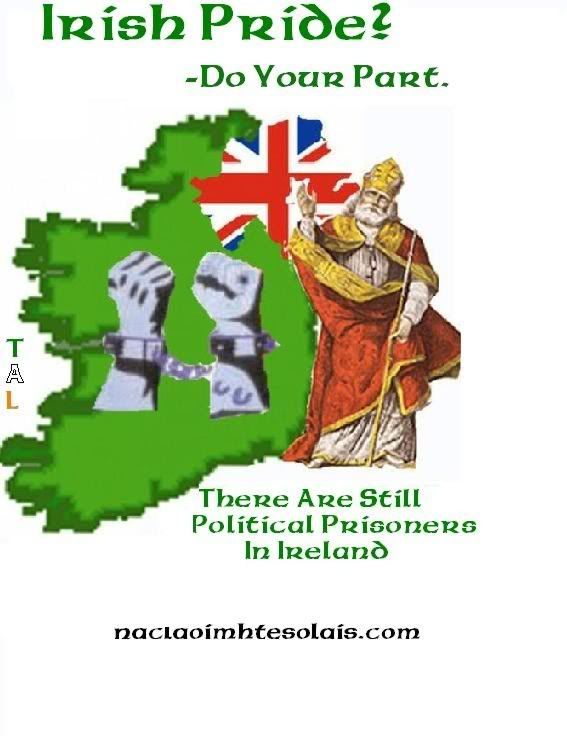
Noel Maguire is the last remaining Irish political prisoner still incarcerated in an English jail.

All his co accused have been repatriated as was their rights as Irish Citizens

Reasons Noel should be repatriated:

• He is an Irish citizen and holds a valid Irish Passport, issued in
Dublin

• He easily qualifies for repatriation under the European directive,
Which allows prisoners to be moved back to their own country to
Serve their sentence closer to their family for purely humanitarian
Reasons. He has not seen his children in 6 Years.


• There was an attempt to murder Noel last year in which he received
Serious knife wounds.

If left alone and isolated his life would be
Constantly under threat!

• His physical and mental well being is in jeopardy if the Irish
Government refuses him the right to be brought home to serve his
Sentence in an Irish Jail

Contact this email Politicalstatus@AOL.com

Support Noel Maguire in his fight as an Irish Citizen to be repatriated on humanitarian ground

Noel is a native of Co Fermanagh although he has family and children who live in Ireland he is 36


====================================================================================================================


Urgent Appeal

A cairde

We are urging everyone, friends, members and concerned individuals to assist in our efforts to continue the pressure on the 26 County Government to Repatriate Noel Maguire from England to jails in the 26 counties as is his right.


The names and addresses and sample letter is below so you can use the sample letter provided, reword it or write your own.


Write or e-mail:


Brian Lenihan

Minister for Department of Justice, Equality and Law Reform

Department of Justice, Equality and Law Reform
94 St.

Stephen's Green
Dublin 2
Phone: + 353 1 602-8202

Email : pagemaster@justice.ie


Constituency Office

Laurel Lodge Shopping Centre
Dublin 15
Phone: + 353 1 822-0970


Addresses to send letters to Contact in USA


EMBASSY OF IRELAND, WASHINGTON DC

ADDRESS:
Embassy of Ireland
2234 Massachusetts Ave.

NW
Washington, DC 20008

TELEPHONE:
(202) 462 3939

FAX:
(202) 232 5993

==============================================================

CONSULATE GENERAL, NEW YORK

ADDRESS:
Consulate General of Ireland
Ireland House
345 Park Avenue
17th Floor
New York NY 10154-0037

TELEPHONE:
General Information - (212) 319 2555

FAX:
Consulate : - (212) 980 9475

E- MAIL:
congenny@AOL.com


==============================================================
CONSULATE GENERAL, CHICAGO
ADDRESS:
Consulate General of Ireland
400 N.

Michigan Avenue, Suite 911
Chicago, IL 60611

TELEPHONE:
(312) 337.

1868

FAX:
(312) 337 1954

E- MAIL:
irishconsulate@sbcglobal.net

==============================================================

CONSULATE GENERAL, SAN FRANCISCO

ADDRESS:
Consulate General of Ireland
100 Pine St.

, 33rd Floor
San Francisco, CA 94111

TELEPHONE:
(415) 392 4214

FAX:
(415) 392 0885

E- MAIL:
irishcgsf@earthlink.net


==============================================================

CONSULATE GENERAL OF IRELAND, BOSTON

ADDRESS:
Consulate General of Ireland
535 Boylston Street
Boston, MA 02116

TELEPHONE:
(617) 267 9330

FAX:
(617) 267 6375

E- MAIL:
irlcons@aol.com

==============================================================
Sample letter


Dear Sir

I write to you on behalf of the Noel Maguire as it concerns his repatriation back to Ireland from a British jail and your refusal to accept Noels application thus seemingly stripping him of his Irish Citizenship and the civil rights that are associated with it.


It is unconscionable that the Irish government continues to refuse to repatriate Noel. It is claimed that he has no close relatives living in the 26 counties, this is untrue as Noel's wife and their two children in fact live within an hour’s drive of Portlaoise Prison in Co Laois and are willing to visit him should he be repatriated. He also has two sisters and a brother in Ireland.


Noel Maguire - who is from Co Fermanagh but hold a valid 26 County passport more than qualifies for repatriation on the grounds of the European Directive as an Irish National.


His mental and physical health must be close to breaking point with the way he is being unfairly treated these continued delays which are tantamount to psychological torture.


On humanitarian grounds I ask that the decision to refuse repatriation be reconsidered and he can return home to serve his sentence and be closer to his family.


Please act now!

Thank you.


Is mise Le meas

"Your Name"

Wednesday, May 07, 2008

The 5th of May (from the Pensive Quill)

Go raibh maith agat, a TJ.

Aontaim leat a chara. Agus tá fáilte romhat.

The 5th of May is a solemn occasion in the republican calendar. Few republicans young or old would fail to instantly recognise it as the dateon which the leader of the H Blocks IRA, Bobby Sands, lost his life aftera 66 day hunger strike against the degenerate policies of a malign andmurderous British government. Those 66 days came back-to-back on a thousand plus days spent naked, locked in a cell as punishment forrefusing to wear prison uniform because to do so would have legitimised British state terror and criminalised republican opposition to it.

In the protest blocks brutality, every bit as much as boredom, was the tireless adversary endlessly gnawing away at the will to resist. The boredom Bobby Sands fought through prolific writing, and while he couldnever hope to halt it he also used his pen to highlight the brutality.

Apart from being, in the words of the late Denis Faul, the greatest prisonreformer of the last century, he was also one of the great bulwarks against censorship, flouting it with a pen refill and cigarette papers which he had to conceal inside a body cavity to foil the censors.

The lengths to which punitive vindictive thugs at all levels of the British penal administration exercised their minds in the search for new ways to inflict deprivation, has long forced me to ponder on what Hanna Arendt termed "the banality of evil."
Shortly before he died Bobby wrote:

There is a certain screw here who has taken it upon himself to harass me to the very end and in a very vindictive childish manner. It does not worry me, the harassment, but his attitude aggravates me occasionally. It is one thing to torture, but quite a different thing to exact enjoyment from it, that's his type.

That somebody as non-banal and prodigious in mind as this gifted and talented IRA leader should die surrounded by so many uniformed morons whose sole intellectual challenge consisted of agonising over whether to kick or punch a naked prisoner, is probably one of the greatest indictments of the British penal establishment in the last century.

Throughout the years of the blanket protest Bobby Sands played a pivotal role in leading the resistance. His day to day struggle on the blanket is finely documented in the biography by Denis O' Hearn. Also meticulously covered in that book is the death agony he underwent. One of the characters in "Gil Courtermanche" characters in Gil Courtermanche brill Kigali, philosophically mused that "dying was simply one of the things you did one day." Death on hunger strike was much less simple. Dying was not something to be done one day. In the case of Bobby Sands, the dying lasted for over two months. The narrative detailing the pain-wracked and prolonged dying does not make for pleasant reading.

Every year at this time those of us who were on the blanket protest, regardless of what political perspective we may hold today, reflect on the tremendous courage of Bobby and those who followed him to certain death.

This was not a death that came like a thief in the night, creeping up on the unsuspecting but one that was seen from a distance and met with an unwavering eye. Margaret Thatcher who displayed a venom all of her own when it came to republican prisoners challenging her writ admitted tohaving admiration for his courage.

Over the past three years there has been much public controversy about the hunger strike generated by the former republican prisoner Richard O'Rawe in his book Blanketmen. In spite of this, regardless of how the hunger strike was managed by the republican leadership, the fact that it evercame about was the direct consequence of an intransigent British government determined to criminalise a political armed struggle brought into being by its own criminal behaviour in the North. Had that government granted at the start of the hunger strike what it conceded at its end it is certain that the strike would never have taken place.

Today I took my children to a local park. On the way we stopped at amonument to all republican hunger strikers who died in the struggle against the British. My wife photographed us there. As they later laughed and played in the park, the words of Bobby Sands that our revenge wouldbe the laughter of our children played back and forth though my mind. 27 years ago it was all so different. Then there was nothing but suppressed tears and a hatred so burning there seemed nothing capable of dousing it. Time may have dulled the hatred but has done nothing to diminish the awesomeness of Bobby Sands epic victory over malevolence.Photobucket
Is mise le meas,
Tj O Conchair
Irish Republican Socialist Movement
North American Coordinating Committee Member
Prison Welfare Officer
Larkin / Gallagher Cumann
PO Box 901479
Kansas City, Missouri
64190-1479 USA
Irish Republican Socialist Party

The Starry Plough, newspaper of the IRSP

Chicago Hunger Strike Commemoration Committee

__._,_.___
Photobucket

May Day & The Palestinian Working Class Struggle(s)

From: AKTIVEYTOR

Date: May 7, 2008 9:03 AM

On May 1 (May Day) of every year, the Palestinian working class marches in its struggle for national liberation. Today, the Palestinian working class, an integral part of the working class of the world, stands steadfast in its struggle for freedom - despite living under siege and occupation, deprived of all rights, including the right to work and the right to seek employment.


Photobucket
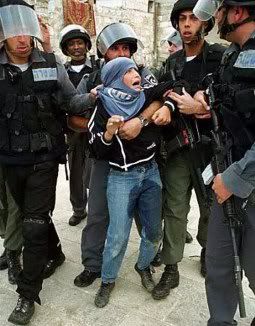
(Young Palestinian woman dragged from her home, without warning, by Israeli troops, they had no warrant, and she had not committed any crime : her only crime was to be born a Palestinian on an occupied "territory". In this photo you'll notice that she is so distraught that she has urinated in her pants. But the Israeli troops don't care about this young Palestinian mother, they must punish this woman for being Palestinian ! And they call this "democracy" !! ??!! -- Rory Dubhdara)

The entire Palestinian people are subject to a collective punishment that not only deepens poverty and creates a crisis of unemployment but also continues the policy of the Zionist forces maintaining the Palestinian working class as a reserve army of labor.


Palestinian workers today are part of an ongoing and continuous struggle for liberation. This struggle, with Palestinian workers in the forefront, spans decades and centuries - from the factories in Haifa at the turn of the century and the early resistance to British colonialism, Palestinian workers have spurred the struggle for liberation onward. Palestinian workers in 1936 waged a historic general strike over a six-month period - the longest general strike in the world - as part of the revolt against British and Zionist colonialism.


Photobucket


Indeed, the Zionist movement has constantly attacked Palestinian labor and Palestinian workers, from the time of its inception. As Zionist colonialism spread in Palestine (in alliance with British colonialism) in the 1920s and 1930s, policies banning the hiring of Palestinian workers spread, at the same time that local Palestinian-owned small businesses were forced out of business by larger competitors, often Zionists - creating even more unemployment, in a deliberate attempt to impoverish and dispossess Palestinian workers in their own land. In addition, Palestinians under Jordanian rule were prevented from organizing labor unions by the Jordanian regime, and all attempts at labor organizing were ruthlessly suppressed.


These same types of attacks continue to this day, as siege and closure are used as weapons that first target Palestinian workers. Today, unemployment is once more a mechanism used against Palestinian workers in an attempt to separate them from their homeland. There is a 70% unemployment rate among university youth, and 50,000 unemployed university graduates, and 120,000 Palestinian workers without jobs. That number reached 200,000 after 3,900 factories were shut down out of the 4,000 factories operating, due to closure and siege.


At the same time that the oppression of Palestinian workers has always played a central role in Zionist colonialism and occupation, the Palestinian workers have always played a leading role in pushing the revolution forward and constantly building the resistance. Palestinian workers - and farmers and peasants - have always made up the main forces of the resistance, and Palestinian workers' and labor organizations have played a key role in resisting occupation. The role of the Palestinian working class in the first Intifada was key, as labor organizations and trade unions and worker-led committees played a key role in organizing and coordinating resistance and protest. General strikes and mass closures of stores and factories, among many other activities of the Intifada, were coordinated by the labor unions, with broad participation and leadership of Palestinian workers. The Palestinian labor movement has given dozens of martyrs and countless prisoners from its leadership, as Palestinian union leaders have always been targeted for assassination and imprisonment.


Photobucket


Within the occupied lands of 1948, the Histadrut, the Zionist so-called "trade union", played a key role as an agent of the zionist state rather than a workers' organization. The slogan of "Hebrew labor" has governed the activities of the Histadrut, which for decades excluded Palestinian and Arab workers from its membership. At its inception, the Histadrut placed as its key goal "conquering" Palestine for Jewish labor - away from Palestinian Arab labor. For years, the Histadrut collected dues from Palestinian workers while providing them with no services. When, in the Oslo period, the Histadrut finally agreed to pay the Palestinian union federation, the Palestinian General Federation of Trade Unions, some compensation for the millions upon millions of dollars taken from Palestinian workers, the Histadrut soon abandoned its promise. The Histadrut has played an integral role as a part of the structure of the racist, colonial-settler state of Israel - rather than representing workers, it represents Zionist racism, and has, in fact, been an enemy of Palestinian workers. The role of the Histadrut has reflected that of the so called "Israeli left," a so-called left that is founded on the racist principles of Zionism and finds no accomodation, solidarity or space for the liberation of Palestinian workers.


In addition, the Palestinian trade union sector of today is corrupted. It must be rebuilt, fully and completely, on a democratic basis with full participation of all forces. Palestinian workers need a leadership and an organization that represents them and the valor and steadfastness of their struggle. In addition, the Palestinian Authority itself has deprived Palestinian workers of their rights - refusing to pay salaries and wages to many workers, including teachers, engineers and employees of the general public sector, in an attempt to exercise political control over the political activities of Palestinian workers. Indeed, the Prime Minister of the Ramallah government is none other than Salam Fayyad, a former representative of the World Bank and the International Monetary Fund. These organizations, known around the world for their anti-worker policies of forced corporatization and imposed "austerity," have, in Palestine, played the same role they have elsewhere, of fostering exploitation and imperialism. The World Bank has been key in developing a plan to create so-called "industrial zones," into which Palestinians, dispossessed of their land, would travel to work, in an environment geared toward foreign exploitation, rather than Palestinian economic development, and without trade unions or labor protection, in prison-like conditions, surrounded by the racist annexation wall.


Similar forces of repression have been arrayed against the Arab workers' movement on a national level. The rise of hunger and poverty in Egypt graphically illustrates the dreadful conditions of Arab workers. Iraqi workers, organizing under and against occupation, face the threat of military occupiers and a puppet government, and vast exploitation exists of international workers in the Gulf. At the same time, the movement of Egyptian workers for their rights, against hunger and poverty, is an inspirational symbol of the rise of a revitalized Arab workers' movement, as are the oil workers of Iraq, organizing and fighting despite occupation. Today, we salute all Arab workers in our common struggle against imperialism and exploitation. Arab wealth gained from oil resources can and should go to the workers who make such wealth possible, and to support the Palestinian cause - not to regimes and rulers who exploit Arab labor and seek to use the people's resources for their individual interests.


On an international level, there have been tremendous victories for the working class in recent years, despite the international balance of power heavily favoring U.S. imperialism. Throughout Latin America, for example, workers' and people's movements have moved towards throwing off the shackles of imperialism and exploitation.


This May Day, we call upon the workers of the world and the international labor movement to support Palestinian workers in our struggle for liberation. The solidarity of working class forces around the world, particularly the workers of the United States, is needed. The Histadrut, a racist arm of the Zionist state that has done nothing but aid in the exploitation of Palestinian workers, should be boycotted and unwelcome at all labor functions. Israel Bonds are not a fit investment for a labor organization - they are an investment in a racist, colonial state. The U.S. labor unions hold billions of dollars in such bonds; now is the time to divest from Israel Bonds and make it clear that racism is the common enemy of all workers, around the world.


In addition, the labor unions of Europe have key roles to play in fostering solidarity with Palestinian workers. The ruling class in Europe, the U.S. and Canada support Israel - the organizations of workers can and should take their role in supporting the struggle of Palestinian workers for liberation and against racism and colonialism. Indeed, there have been promising and important developments, and we salute the workers and workers organizations that have taken part in the growing movement to demand the full international isolation of Israel, including economic boycott. Most recently, the Canadian Union of Postal Workers passed an important resolution at their most recent conference urging boycott, divestment and sanctions against Israel because of its denial of Palestinian rights, including the right of Palestinian refugees to return, and including its repression against Palestinian workers, including postal workers who daily must brave numerous checkpoints merely to deliver the mail. Such initiatives are important and should be widely replicated by the international labor movement.


Today, the PFLP is calling upon the Palestinian left and Arab left to unify our forces into one working-class front. This is a historical moment for the left, and it is critical that we rise to our responsibility in defending the working class, and we are committed to working toward that end. Any victory for the Arab working class - and the international working class - shall immediately impact the Palestinian working class.


Photobucket
On May Day 2008, one hundred and twenty-two years after the first workers marched on May 1 through the streets of Chicago to demand an eight-hour workday and justice for our class, the Popular Front for the Liberation of Palestine salutes the workers of Palestine, the Arab nation, and the world, in our common struggle against exploitation and oppression, to break the chains of Zionism and imperialism.


Victory to the workers of the world!

Por El Popular Front for the Liberation of Palestine
Photobucket

Who's Uncle is Really Crazy ? Political Prisoner Mumia Abu-Jamal Answers the International Question


Who's Uncle is Really Crazy?
[col. writ. 5/1/08 (c) '08 Mumia Abu-Jamal


When conservative hit-shows first began raising questions about Barack Obama's former pastor, Rev. Dr. Jeremiah Wright, the Democratic candidate essentially played down the relationship, suggesting that Wright was like the 'crazy uncle' common to many families.

Due to the pressure of the 24 hour news cycle, we have come a long way from there, to here.

While Sen. Obama no longer refers to him in this way, it's more than worthwhile to examine just what the Rev. Wright did say, which set off the belfry of mad bats who hold forth from the dark universe of right wing radio and TV commentators.

Among the Rev. Wright's "controversial" comments were these:

"We bombed Hiroshima, we bombed Nagasaki, and we nuked far more than the thousands in New York and the Pentagon, and we never batted an eye... and now we are indignant, because the stuff we have done overseas is now brought back into our own front yards. America's chickens have come home to roost... Violence begets violence. Hatred begets hatred. And terrorism begets terrorism. A white ambassador said that y'all, not a black militant... An ambassador whose eyes are wide open and who is trying to get us to wake up and move away from this dangerous precipice upon which we are now poised..."

Rev. Wright's words on how America has treated her darker citizens were also termed "controversial. " These are some of them:

"And the United States of America government, when it came to treating her citizens of Indian descent fairly, she failed. She put them on reservations. when it came to treating her citizens of Japanese descent fairly, she failed. She put them in internment prison camps. When it came to treating her citizens of African descent fairly, America failed. She put them in chains, the government put them on auction blocks, put them in cotton fields, put them in inferior schools, put them in substandard housing, put them in scientific experiments, put them in the lowest paying jobs, and put them outside the equal protection of the law, kept them out of their racist bastions of higher education and locked them into positions of hopelessness and helplessness. The government gives them the drugs, builds bigger prisons, passes a three strike law and then wants us to sing 'God Bless America.' No, no, no, not God Bless America. God damn America-that' s in the Bible - for killing innocent people."

On the role of the U.S. government overseas, Wright preached the following:

"Governments lie. The government lied about the Tuskegee experiment.. . The government lied about bombing Cambodia...The government lied about the drugs for arms Contra scheme orchestrated by Oliver North... The government lied about a connection between Al Qaeda and Saddam Hussein and a connection between 9-11-01 and operation Iraqi Freedom. Governments lie."

I don't know about you, but I've not heard one statement that isn't categorically, historically, and absolutely true. As my good country buddy, Bro. Willie might ask, "What the problem is?"

Obama's response, served up to placate the fascistic right, sounded like an apology: "I reject outright statements by Reverend Wright that are at issue."

The problem isn't that Rev. Wright was crazy, but that he spoke the cold, sober truth. That's the problem.

The US nationalists demand that anyone who states such truths be 'denounced.'

When will a candidate emerge who will denounce imperialism, and the endless ruinous wars against much of the Third World, for the profit of corporations here?

If this election is any measure, no time soon.

Who's uncle is really crazy? Uncle Jeremiah or Uncle Sam?


--(c) '08 maj

Thursday, May 01, 2008

RADIO REBEL GAEL May Day Show ! Irish Rebel Balladeers & Paddy Punkers of the World Unite !!

Photobucket - Video and Image Hosting


  • Radio Rebel Gael

  • The Bronx Voice of Musical Rebellion :

    Presents The May Day Paddy Proletarian Show!

    In defense of the Working Class Hero
    Against the Corporate Zero !


    Cheers Lads, Lasses, Irish Rebels, Irish-Americans, Indigenous Gaels, and all good Socialist-minded comrades, no matter your religious or ethnic background, RADIO REBEL GAEL, wishes to give a shout out to all the Working Class Heroes & Heroines, breaking their backs to feed their family, keep food on the table and fighting back for Worker's Rights !


    I want to give a shout out to all good socialist comrades of the world !

    Featuring New Music By :


  • Damien Dempsey
  • (from the new album "To Hell or Barbados" !)

  • Dancin' Knuckles
  • (from their brilliant "28 Strings" ! )

  • The Gobshites
  • (from their new album "Get Bombed" !)

  • Mischief Brew
  • (from their new album "Smash The Windows" !)

  • Meisce
  • (from "Shipwrecked In A Bottle" ! )

  • Mutiny
  • (from "Co Op Brewery")

  • Flatfoot 56
  • (from their new album "Jungle of the Midwest Sea")


  • The Mahones
  • (from their new split album with Catgut Mary)

  • Flogging Molly(from their new CD "Float" !)

  • JD & The Longfellows
  • (from their latest release "Happy Hour Again" !)


  • Derek Warfield & The Young Wolfe Tones(from their new double CD "God Save Ireland!")

  • The Vandon Arms


  • The Killigans
  • (from their new hit album "One Step Ahead of Hell ")


  • Shebeen
  • (from their new album "Jackets Green")


  • Ciaran Murphy


  • Photobucket

    And Old Favorites By:


  • Ray Collins


  • Claymore


  • Blood or Whiskey

  • The Larkin Brigade


  • Sharky Doyles


  • NECK: London-Irish Psycho-Ceilidh


  • The Tossers
  • (from their last release "Agony")

  • Greenland Whalefishers


  • Saint Bushmill's Choir


  • The Wakes


  • Whiskey Galore


  • Photobucket

    And a helluva lot more !

    Photobucket


    Go raibh maith agat ! Rory Dubhdara, Radio Rebel Gael


  • Radio Rebel Gael

  • Monday, April 07, 2008

    WOMEN'S STRUGGLE LIBERATES IRELAND

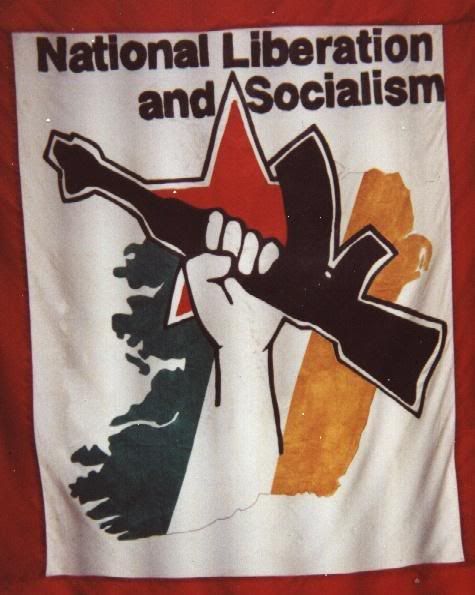
    WOMEN'S STRUGGLE LIBERATES IRELAND/ IRELAND'S STRUGGLE LIBERATES WOMEN: FEMINISM AND IRISH REPUBLICANISM


    by Jan Cannavan
    Irish Women's History Group
    **********
    Photobucket

    Ever since feminism's "Second Wave" emerged in the wake of the anti-Vietnam War movement, women around the world have debated the compatibility of national liberation and women's liberation. Several questions predominate: Which movement is more likely to liberate women? If both are necessary, how will they fit together? And what about other oppression many women face, such as classism and racism?

    This paper will examine these issues as they relate to women in Ireland. It will put Ireland's national liberation and women's liberation into their historical contexts. It will next describe the Irish women's current social and economic conditions.Finally, it will compare and contrast the roads to women's liberation envisioned by feminists and Irish Republicans.

    Ireland's colonization by Britain was begun with the Anglo- Norman invasion of 1169, and it was completed by 1652 under Cromwell. The British government removed the native Irish from their lands and planted loyal colonists in their stead. The native Irish were governed by the Penal Laws, an apartheid code,which forbade them to own land or horses, practice theirreligion, participate in government or educate their children. This repression spawned secret societies and agrarian revolt in every generation. Many Presbyterian planters were sympathetic to native Catholic grievances, as they were nearly as oppressed legally by a colonial administration which restrained trade and deliberately kept Ireland underdeveloped. Following the examples of the American and French revolutions, the dissatisfied elements within Ireland coalesced into the United Irishmen, a movement for an independent Irish Republic. After many failed risings, this goal was partially realized in 1921 with the winning of limited independence for 26 of Ireland's 32 colonies.


    Irish Republicans, however--along with the majority of nationalists never accepted Ireland's partition, and they are still fighting for a united, socialist Ireland. Irish women historically saw their gender's liberation intertwined with their nation's. In Celtic Ireland before the conquest, women enjoyed many legal rights which aren't equalled in most countries today. Women kept their own property in marriage, and neither partner could enter into any contract or business deal without the other's consent.


    (1) Both husband and wife were allowed liberal grounds for divorce.A wife could divorce her husband for fourteen reasons, including his slander of her or for his sexual inadequacy.

    (2) Women were also legally protected in common-law and transient relationships, and no children were considered illegitimate (3).

    The British conquest brought Ireland's independent legal system to an end and removed most of Irish women's traditional rights. It also brought sexual prudery, which hadn't previously been part of Irish culture. Pre-conquest church ruins in Ireland contain carvings of sile-na-gigs, naked female forms with hugh exposed genitals, often show masturbating.

    One Celtic tradition which the conquest did not bring to an end was the existence and acceptance of strong warrior women.In the Tain bo Cuailgne or Cattle Raid of Cooley, Ireland's main mythological saga, the warrior Queen Maeve led her army to
    victory, drowning one opposing army in a flood of urine and menstrual blood. And in Elizabethan times, Grainne Mhaol led her clan in pirate raids on British ships, later negotiating with Elizabeth as an equal. In every Irish rebellion, women fought alongside men and took part in all activities. But most of this women's history has been obscured and is only lately being rediscovered. For example, contemporary accounts of the 1798 rebellion list many women's actions; but later histories have dropped almost all these incidents. Feminist demands also accompanied nationalist struggles, at least from 1798 on. Mary Ann McCracken, a United Irishwoman, was an admirer of Mary Wollstonecraft. Before joining the society of United Irishwomen, she wrote to an imprisoned friend that she wished "to know if they have any rational ideas of liberty and equality for themselves or whether they are content with their present abject and dependent situation, degraded by custom and education beneath the rank in society in which they were originally placed." (4)

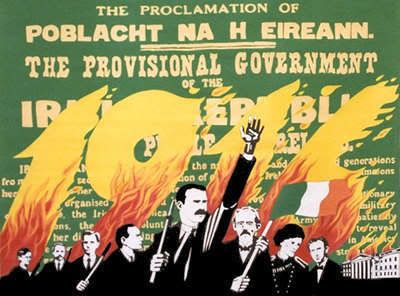
    By the Easter Rising of 1916, three movement had joined forces to take advantage of Britain's preoccupation with the World War: the nationalist movement, the labor movement and the woman's movement.This alliance meant that a progressive social
    program for worker's and women's rights accompanied the demand for national liberation. James Connolly, a socialist theoretician and one of the rebellion's executed leaders, supported the woman's suffrage movement. In 1915 he wrote:
    "The worker is the slave of the capitalist society, the female worker is the slave of that slave. " (5)
    And in 1918, when the Republicans won a landslide electoral victory and set up their own (illegal) parliament, Constance Markievcz--a 1916 leader--was named Secretary of Labour. She and Alexandra Kollantai in the new Soviet Union were the first women at cabinet level. (6)

    Photobucket


    The partition of Ireland and the ensuing Civil War ensured the victory of pro-British, socially conservative forces in government. In the 1930's many of the remaining Irish radical leaders fought and died for the Spanish Republic.This paved the way for the 1937 Irish Constitution, Article 41 of which states that "by her life within the home, Woman gives to the State a support without which common good cannot be achieved." (7) In the late 1960's the Northern Ireland Civil Rights Association, inspired by the African-American Civil Rights Movement, waged a non-violent campaign to win equal rights for the Catholic nationalist people of the partitioned Six Counties.Women made up a large proportion of this movement but, except for Bernadette Devlin, the entire leadership was male.When peaceful marches were continually beaten and shot off the streets (culminating in Bloody Sunday, January 1972, when British paratroopers killed fourteen unarmed demonstrators), the armed
    struggle was resumed.
    Also in the early 1970's a woman's movement was emerging in Dublin, inspired by those in the United States and other European countries.Irish feminists agitated for reforms in the welfare system for single mothers, for access of women to equal jobs, pay and education, and for legal divorce and contraception.(8) One of the women's first actions was the Contraception Train to Belfast in May, 1971. (9) Since contraceptions were legal in Northern Ireland, 47 women travelled there and brought large quantities of contraceptives, which they openly declared at Irish Customs on their return.This action attracted a lot of media attention and sparked a large campaign, which led to the partial legality of contraception.

    In 1975 the Northern Ireland Women's Rights Movement was founded in Belfast to demand parity with British laws on women's rights.This was a middle class, legalistic movement, which took no position on working class or nationalist women's issues.The following year, when the NIWRM criticized the Troops Out Movement, a Socialist Women's Group split off from it. Then in 1977 the Socialist Women's Group split again, and the Belfast Women's Collective was formed to work more closely with the Republican Movement, especially around women's prisoners issues. A final split, in 1978, produced Women Against Imperialism, which had even closer links with the Republicans. (10) The centrality of the national struggle and the polarized positions on it kept a united feminist movement from developing in the North of Ireland.

    To understand women's conditions in Ireland, one needs to know a little bit about Irish society and its economic conditions. The occupied Six Counties of Northern Ireland is a British colony, ruled directly from London. The southern 26 counties, or "Irish Republic", is s neo-colony--nominally independent but with its economy completely dominated by multinational investment. In economic terms, Ireland is a Third World country. Officially, unemployment in both parts of Ireland exceeds 17 percent. But in some working class areas, it is over 80%. Politically, both parts of Ireland are conservative confessional states.The south is dominated by the Catholic Church, and the north by fundamentalist Protestantism. Both states are extremely conservative in social legislation, and both use repressive measure and censorship to try and maintain the status quo.These social and economic condition impact heavily on women. Although more women have entered the labor force in recent years, they are highly concentrated in service industries. (12) Women in the 26 Counties earn only 60 per cent of male wages, while those in the Six Counties earn 75.5 percent. (13) Over 1.25 million Irish women (at least half the female population) is classified
    as living in poverty.(14) Women's social conditions, influenced by strong links between conservative churches and states, haven't improved significantly since the early 1970's.

    Contraceptives can now be legally prescribed in the 26 Counties, but many doctors and pharmacists, especially in rural areas, refuse to provide them.Condoms can only be sold in pharmacies, and a record store in Dublin which challenged them was prosecuted successfully in 1990. Abortion, which has always been illegal in Ireland, was made unconstitutional in a 1983 referendum.Even non-directive pregnancy counseling, with options for abortion in Britain discussed, is illegal. In the North abortion is also illegal, even though Northern Ireland is supposed to be an integral part of Britain. Divorce is still illegal in the 26 Counties, although a campaign is growing for a new referendum on this issue. Women in Northern Ireland also have to contend with sexist harassment from armed soldiers on their streets, constant house raids, strip-searching, and caring for families alone while their husbands or imprisoned or on the run.
    Feminists and republican feminists propose different solutions for women's oppression. The largely middle-class feminist movement sees the solution as working toward equality and gender-neutrality in the legal system.The Commission for the Status of Women, a government-appointed advisory body, recommended many changes in employment and social welfare laws, which ameliorated some of the worst inequalities. (15) Many feminists also see the need for steps beyond formal equality, such as day care facilities, maternity leave and control of their own fertility, as necessary prerequisites for equality.Single-issue campaigns on many of these issues have been and are being fought by feminist groups.Women's cultural groups, such as writing groups, self-help therapy groups, sports groups, etc.are seen by many as "an alternative environment in which women can explore ideas and support each other away from the constraints imposed by patriarchal structures." (16)

    Republican feminists say that this approach is too fragmented, dealing with symptoms, rather than the cause of women's problems, which they see as capitalism and British imperialism, along with patriarchy. As Mary Nelis, a Derry Sinn Fein activist, puts it: "The system of patriarchy, with its sub- structures of imperialism and capitalism, can accommodate reforms and even allow women to be the power figure head ( e.g.Maggie Thatcher) given that the ground rules establishing essential inequality remain intact." (17)

    The fragmentation of a multitude of single-issue women's groups, each lobbying against the others for funding and attention, is seen by republican feminists as "the old divide and conquer trick".(18) They also believe that "the state apparatus, to an extent, has absorbed the women's movement.The more acceptable feminists have become part of the establishment and enjoy the freedom of the airwaves, which we, as Republicans, are denied under Section 31 {26 Counties censorship law}. So what is the real threat?" (19) Nell McCafferty, a feminist journalist whose work is known around the world, had broken laws on behalf of women's rights to contraception for years and had reported on this "criminal activity". As she said, "It did my career no harm at all." (20) But then she gave an interview expressing support for the IRA. She was immediately banned from Irish airwaves.


    Feminist objections to the Irish Republican struggle usually fall into three main categories: (1) "It's a man's war"; (2) "Women should concentrate on our own liberation as women;" and (3) "It's different from legitimate struggles in the Third World." (21)

    Cathy Harkin of Derry Women's Aid, a refuge for battered women, put forth the first objection. She calls Derry "an armed patriarchy" and says that women in the Republican Movement have "seldom risen to positions of authority except where they adopt the male ideals, aims and discipline of the movement. " (22) This argument, which has been debated in feminist circles for years, presupposes that women are "naturally" pacifist and that any women who takes part in a struggle which includes a military component is going against her true nature and only following men.

    This is a dangerous argument for feminists to make, because women's supposed biological and psychological "differences" have been used against them through patriarchal history. Besides, as women IRA Volunteers have stated, "This is not a man's war, but a people's war.(23)

    Margaret Ward, a feminist historian, raises the second objection. She asks, "Can feminism offer such unqualified support (to national liberation) and retain its ability to encompass the reality of all women's oppression, to fight without compromise for women's interests?" (24) This criticism raises two questions (1) What are women's issues? and (2) Is the Irish Republican Movement fighting for them? To the first question, the Irish Women Prisoner of War have answered, "Women within the occupied Six Counties of IReland are oppressed by both a foreign imperialist state and the sexist ideologies which suppress women worldwide." (25) And Bernadette Devlin McAliskey added that "We are not oppressed simply because we are women but also because we are working class women and because we are working class republican women. " (26) As a woman Sinn Fein activist stated, "Just because as issue also affects men, doesn't mean it's not a woman's issue." (27)

    But what about the issues that are specifically of interest to women? As asked in question 2 above, is the Republican Movement fighting for them, as well? Sinn Fein has an extensive policy document which states its positions on women's issues. It calls for, among other things, legal divorce; free and accessible contraception; non-directive pregnancy counseling embodying all choice; childcare to be shared by both parents; 24 hour public childcare; and an end to stereotyping of sex roles in education and advertising.(28) Plus, Sinn Fein members are active in women's center and in campaigns for divorce, non-directive pregnancy counseling, and against rape and battering.

    The third objection to Republicanism, that it isn't a bonafide Third World movement, has been dealt with earlier in this paper, where Ireland's economic status as a Third World country was explored.
    Many people are more comfortable supporting liberation movements that are far away from their home and are waged by people who look different from them or speak a different language than they are supporting a movement closer to home.The distance and suspicion between feminists and republicans is harmful to both movements and to all women's liberation. As the coordinator of the Falls Road Women's Center in Belfast explains, "The right wing has no trouble in uniting to defend its interests while using the distortions caused by British imperialism to divide us and divert our energies." (29) The inability of the women's movement to mount an effective opposition to the current conservative backlash is attributed by Marron to this "sectionalism and fear." (30)

    Both the feminist and Republican movements have a lot to offer each other and the Irish people.

    Nell McCafferty comments that :

    "It has so far proved easier to feminise Republicans, who have much to gain from the inclusion of women in the struggle, than to Republicanise feminists, who have much to lose if women's interests are totally subordinated to a resolution of the war.

    "However, experience around the world shows that social protest struggles have been obliged to take steps to resolve sexist problems once the women's movement has become involved...
    "It poses a challenge to the Irish women's movement of developing a theory and practice on feminism and war.The active involvement of women is imperative if women are to have, when the war is resolved, the freedom of free men. " (31)

    **********

    NOTES

    1.Donncha O Corrain, "Women in Early Irish History," in "Women In Irish Society: The Historical Dimension", eds Margaret MacCurtain and Donncha O Corrain (Westport, CT: Greenwood Press, 1979), p. 2.


    2. ibid., p. 6.


    3. ibid., p. 4.


    4.Mary NcNeill, "The Life and Times of Mary Ann McCracken: A
    Belfast Panorama" (Belfast: Blackstaff Press, 1960), p. 126.

    5. James Connolly, "Selected Writings", ed P.Berresford Ellis (New York: Monthly Review Press, 1973), p. 191.
    6.Margaret Ward, "Unmanageable Revolutionaries: Women and Irish Nationalism" (London: Pluto Press, 1983), p. 137.
    7. Ibid., p. 238.
    8. Jenny Beale, "Women in Ireland: Voices of Change" (Bloomington: Indiana University Press, 1987), pp. 3-4.

    9. Ibid., pp. 106-107.

    10. Kevin Kelly, "The Longest War: Northern Ireland and the IRA
    (Lawrence Hill, 1982), pp 320-322.

    11. Alternative Ireland Directory, 4th ed. (Cork, Ireland: Quay Co-op, 1990), p. 176.
    12. Ursula Barry, "Lifting the Lid: Handbook of Facts and Information on Ireland" (Dublin: Attic Press, 1986), p. 34.

    13. Alternative Ireland Directory, p. 4.

    14. ibid.


    15. Beale, p. 186.


    16. Ibid., p. 193.


    17.


    Mary Nelis, "Real Change Still Beckons" in "Unfinished
    Revolution: Essays on the Irish Women's Movement" (Belfast:
    Meadbh Publishing, 1989), p. 5.


    18.


    Mairead Keane, head of Sinn Fein Women's Department,
    unpublished speech (1989).


    19.


    Rita O'Hare, Sinn Fein Publicity Director, unpublished speech
    (undated--about 1987).


    20. Nell McCafferty, "My Phone Doesn't Ring Anymore...", from
    "Labour and Ireland", no. 20 (March, 1988).


    21.


    Jan Cannavan, "Irish Freedom Fighters", from "Womanews", 9,
    no. 3 (March, 1988).


    22. Nell McCafferty, "The Armagh Woman", p. 88.


    23.


    "Notes for Revolutionaries" (Belfast: Republican
    Publications, 1983), p. 1.


    24. Ward, p. 262.


    25.


    Women POWs, Maghaberry Gaol, "Women and the National
    Struggle", from "Women in Struggle", no. 1 (Spring, 1991), p.14.


    26.


    Bernadette Devlin McAliskey, "What Price Reunification?" from
    "Counterspy", 8, No.2 (December, 1983), 41.


    27 Cannavan, p. 7.


    28.


    "Women in Ireland: Sinn Fein Women's Policy Document" (Sinn
    Fein, 1992).


    29.


    Oonagh Marron, "The Cost of Silencing Voices Like Mine" from
    "Unfinished Revolution: Essays on the Irish Women's Movement", p.


    42.


    31. McCafferty, "The Armagh Women", p. 30.


    *********

    For further information on women in Ireland, please contact:

    The Irish Women's History Group
    922 East 15th Street, Apt. 1A
    Brooklyn, NY 11230
    tel: 718-253-6640


    Photobucket

    Tuesday, March 25, 2008

    STATEMENT FROM PORTLAOISE PRISONERS OF WAR

    [irsm_news] Statement from Portlaoise POWs


    Thanks, TJ

    PhotobucketStatement on behalf of Republican Socialist Prisoners, Portlaoise.


    Photobucket

    The Republican Socialist Prisoners in Portlaoise send each of you here today our heartfelt comradeship.

    Today we remember with pride all those who gave their lives in pursuit of a 32 County Republic and today we as republican socialists will also proudly march behind the red flag and starry plough.


    Photobucket

    Easter is a sad time for many of us; it is also a time for reflection where we pledge to redouble our efforts in rebuilding the RSM.

    Each of you here today have a part to play in this movement; the movement needs all of you to play a part as we put forward the analysis of our politics.


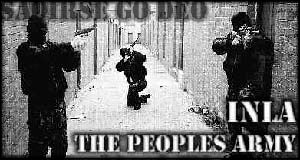
    We wish to take this opportunity to salute the leadership and the volunteers of the noblest army of the people, the INLA.

    We salute the Ard Comhairle of the IRSP and its activists and we send solidarity greetings to our friends, our families, and our comrades.


    The revolutionary Socialist Ireland preserved by our movement will not be achieved by taking seats in another Dail or Stormont, neither will it be achieved by naked pursuit of power for the sake of power and rank as reflected in our recent history by the antics of the Provisionals / Sinn Fein whose antics to achieve power at any cost besmirches the memory of all Volunteers who died in the struggle for Irish unity and mocks the efforts of all Volunteers who were imprisoned over the years.

    Just a few weeks ago Adams and his cohorts had the audacity to hijack the funeral of
    Brendan the “Dark” Hughes.

    The Dark had already spoken of his contempt for Adams and his cronies, that episode left many true Republicans with a bitter taste in their mouths.


    As our Movement continues to grow much to the annoyance of our enemies, we call on all our activists to become more involved in relevant issues both at local and national level.

    The campaign at Rossport against the exploitation of our natural resources and the campaign to save Tara and our cultural heritage need to be supported.


    At this present time our movement is facing a vicious onslaught from the Free State lackeys and right wing media, our members are been subjected to draconian laws designed to intern our activists, WHY?, ……because they fear the politics of men like James Connolly, Seamus Costello and Gino Gallagher.


    Photobucket
    The heart of Gino beats strongly within our wing and we feel his presence and we are sustained by it.

    Each part of our movement is equally important as together we are an unbreakable fist.

    We thank you all for your support shown to us over the past year Willie Gallagher, Paddy Wall, Cocker Murray, Declan Duffy and the Dundalk Comrades deserve particular praise, we salute you all for your kindness.

    As our numbers are increasing, we ask that each Cumann appoints a POW rep.


    We are with you in spirit, Victory to the soldiers of the INLA.


    Photobucket

    Sunday, March 23, 2008

    RADIO REBEL GAEL Remembers the Men and Women of Easter Week

    Photobucket - Video and Image Hosting


    Presents the Easter Rising of 1916 Commemoration Show:

    with special interview with Irish Republican Socialist and Irish Rebel musician, Ray Collins:


  • Ray Collins


  • Never Forget those brave men who gave their lives on Easter week 1916, uncompromising, unswerving, unbowed, never relenting for the cause of Irish Freedom !

    Patrick Pearse (1879-May 3, 1916, shot, Kilmainham)
    Thomas J. Clarke(1858-May 3, 1916, shot, Kilmainham)
    Thomas MacDonagh (1878-May 3, 1916, shot, Kilmainham)
    Joseph Mary Plunkett (1887-May 4, 1916, shot, Kilmainham)
    Edward "Ned" Daly (1891-May 4, 1916, shot, Kilmainham)
    William Pearse (1881-May 4, 1916, shot, Kilmainham)
    Michael O'Hanrahan (1877-May 4, 1916, shot, Kilmainham)
    John MacBride (1865-May 5, 1916, shot, Kilmainham)
    Éamonn Ceannt (1881-May 8, 1916, shot, Kilmainham)
    Michael Mallin (1874-May 8, 1916, shot, Kilmainham)
    Cornelius Colbert (1888-May 8, 1916, shot, Kilmainham)
    Seán Heuston (1891-May 8, 1916, shot, Kilmainham)
    Seán Mac Diarmada (1884-May 12, 1916, shot, Kilmainham)
    James Connolly (1868-May 12, 1916, shot, Kilmainham)
    Thomas Kent (1865-May 9. 1916, shot, Cork)
    Roger Casement (1864-August 4, 1916, hanged, London)


  • Radio Rebel Gael


  • Radio Rebel Gael


  • Radio Rebel Gael

  • Rory Dubhdara, Radio Rebel Gael

    Revolutionary Women in Colombia … and the Death of a Rebel Leader

    Terry Gibbs / Saturday 22 March 2008

    http://www.prensarural.org
    Photobucket
    + Terry Gibbs
    Assistant professor in the Department of Political Science and
    director of the Centre for International Studies at Cape Breton, University in Canada.
    Photobucket
    After a brief introduction, we stood there for a few moments in an uncomfortable silence. How does one kick-off a conversation with a guerrilla leader? Commander Gloria and three other female guerrillas joined us. We all dined on a supper of fish, potatoes and vegetables,which led us into a friendly, but rather surreal, conversation about our favourite types of food. We were told that this was a good week to visit because they had managed to secure some decent food supplies. Sometimes they have little more than bananas and beans to eat.

    The mood became light and we gradually felt comfortable enough to explain why we had come. While Garry was there to interview Reyes himself, I sought to interview women guerrillas. As part of myresearch exploring the role of women in social transformation, I wanted to understand how and why these women had become guerrillas. After an animated discussion about world politics and revolution, Reyes told us we could begin our work the next morning. We were led to our bivouac, which contained planks of wood to serve as a mattress and a tarpaulin draped overhead to protect us from the tropical rains. I lay in our bed thinking about Zen masters and their ability to sleep on anything. Eventually, I drifted off to sleep.

    It was 4:30 am when I was awakened by the mild buzz of hushed voices. I attempted to focus my eyes in the darkness. From my bivouac I could see the faint glow of small flashlights pointed downwards as guerrillas dressed themselves. I had made two trips to the "washroom" during the night with a guide, so I felt confident that I could find my way back there alone without armed accompaniment. The morning air was grey and heavy with damp. Donning my rubber boots and poncho, I made my way along the wooden pathway trying to recognize at exactly what point I had turned right during the night. I didn't want to end up in the male washroom again.
    I returned to the centre of the camp as streaks of light from the rising sun began to penetrate the jungle canopy. I watched the guerrillas in nearby bivouacs efficiently folding everything from their tarpaulin to bed sheets. It was the kind of exercise that reminded me of my mother's stories about the disciplined life in London during World War Two. After a few moments of activity, there were neat, identical piles of tightly wrapped cloth in the corner of each "bed," and not one bug or fleck of dirt was visible. Within moments the sleeping areas were abandoned as the group fell into formation in the large meeting area to receive their orders for the day. Meanwhile, Garry and I spent a good half hour doing a less than stellar version of the guerrillas' morning household chores. We were then called to breakfast, which we ate with Reyes and Gloria. We were joined by two young female guerrillas who were on kitchen duty and an older guerrilla named Gladys, who has been with the FARC and living in the jungle for 32 years—longer than any other woman.

    Many think of Gladys as a mother figure, but not your typical mother. She is responsible for the camp's communications centre and could be seen in her bush office disseminating information via radio. She has been in combat many times over the years. Gladys has known nothing but life in the FARC since she was a teenager. The FARC was her family and she spoke with great pride of her commitment to building a new Colombia where the poor would have a voice and the wealth would be shared equally. Despite being hardened by decades spent in the jungle, tears were visible in Gladys's eyes when I asked her how she kept going after all these years. "I believe in what we are doing, in ther evolution, in social justice," she said. "The vision of a new Colombia keeps me going."
    Photobucket
    While the FARC has been criticized for its violations of human rights, particularly kidnapping, targeted assassinations, and its use of notoriously inaccurate home-made mortars and landmines, some analysts have suggested that it is a mistake to simply dismiss the group as a criminal or terrorist organization— as the Colombian, U.S. and Canadian governments have done. Carolina, who joined the FARC more than 10 years ago, explained that she became involved in the guerrilla group because "I liked the sound of the objectives it was fighting for: defending the interests of the people, the struggle against imperialism, against discrimination, for a radical change in the structure of the government."
    Photobucket
    On the afternoon of our first full day of absorbing camp life, we were eager to bathe and change clothes. Even in this activity, we were struck by the efficiency and order of the camp. Everything happened at a specific time and in a specific way. Even when bathing, we were integrated into the rebel order of things. We were pleasantly surprised by the "bathroom," which thankfully was situated far from the "toilets." It consisted of a warm pool in a free flowing river with an adjacent primitive wooden structure in which one could get undressed and wash clothes. The fact that the male and female guerrillas strip down to their underwear and bath together was at first intimidating, but it soon became apparent that nobody was fazed by it. We entered the water in our underwear and washed both our bodies and our clothes before exiting, drying off and donning clean attire. Each guerrilla had two uniforms and they kept both themselves and their uniforms immaculately clean. While bathing, everyone engaged in light conversation, telling stories and jokes. After watching Garry floundering with soap and his muddy trousers on the laundry table in the running stream, one of the young male guerrillas tried to teach him how to scrub the stains from his pants.

    We were free to roam the camp during the three days we spent with the guerrillas. We observed the rebels receiving commands, doing their chores and spent many hours simply sitting and chatting with them when they had free time. Not only did the guerrillas treat us with great respect, but they also appeared to treat each other that way too. I took these opportunities to get to know some of the female guerrillas. I was focused on finding out why these, mainly young, women had decided to live this dangerous and harsh life in the jungle.

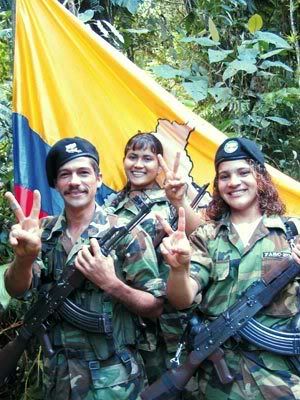
    It is evident that some women in Colombia have, for various reasons, decided that armed struggle is the only way to overcome state repression and the structural problems of poverty and inequality. Women make up more than thirty percent of the FARC's 16,000 fighters. Furthermore, they now constitute approximately forty percent of mid-level commanders in the rebel army. At the same time that these women are succeeding in shifting the gender dynamic within the structures of the traditionally male-dominated FARC, they are also fighting to dramatically change the country's political, economic and social structures.

    Many of the female guerrillas talked about the culture shock of joining the FARC, not only because of the difficult conditions in which rebels live, moving constantly in jungle terrain and living in fear of attack, but because of the extreme contrast between the role of women back in their communities as compared to that in the rebel camps. Many female FARC members come from traditional peasant communities where the hierarchy of the family and the subordination of women in the household are deeply entrenched. So for most of them, the FARC has provided a liberation of sorts from traditional obligations and a recognition of their broader capacities as women.
    Photobucket
    FARC women and men share equally in cooking, cleaning, guard duty and combat. Many guerrillas, both male and female, pointed out that discrimination of any sort is met with sanctions. As one guerrilla stated, "Here, we women say that a woman is not just for sexual exploitation— having kids, washing, cleaning and sweeping. We have to strengthen our own goals, to be someone in this life." Another female guerrilla pointed out, "Here we have rights and responsibilities to live up to. A woman can find herself leading 50 to 60 men, just as a man can. She can give classes in politics and military strategy, and she can lead a team into combat. It's great to see women commanders exercising their authority."

    The principal issues related to gender that FARC women identified did not differ significantly from those highlighted by other Colombian women engaged in non-violent political activities, although the language of the rebels reflected a Marxist orientation. Many political women who have not taken up arms identify poverty, inequality, displacement and political corruption as important issues. FARC women, however, speak also of U.S. imperialism and capitalist exploitation. And while many other women, particularly peasants and residents of the country's poor urban barrios, tend to frame their politics in the very immediate struggles for rights, food, water and land, the FARC women were clearly working towards a socialist society, an overthrow of the existing capitalist order.

    While we are well aware of the fact that many see the FARC as "terrorists, " our experiences in that particular camp made evident the complicated and multifaceted nature of Colombia's war. The guerrillas we met were ideologically committed, respectful, hard working and surprisingly gentle in their manner. And I speak here not only of the women. While we observed the guerrillas engaging in military-like activities, we also saw them participating in a cultural show—singing and reading poetry. They watched the news every night on the camp television and then discussed political events. Once a week they had a "movie night," sometimes they viewed historical films about Colombia or documentaries made by the FARC, at other times it was more traditional Hollywood fare.

    There were many hidden surprises in the camp. Commander Gloria liked to wear make-up. She was Reyes' right-hand person and his partner. One got the sense that she oversaw a great deal of the day-to-day chores in that camp and it was clear that, despite her sense of humour, she could be tough and uncompromising. Many of the young women also wore make-up and liked to dress-up for cultural shows and poetry readings. Living moments of "normal" seemed key to morale in the camp.

    I spent a great deal of time with a young guerrilla named Ana. She insisted on braiding my hair and showed me how to handle her AK-47. I found it hard to reconcile her warm personality with the assault rifle, and a strange sadness overcame me as I listened to her stories. On the morning of our final day, as we prepared to leave the camp on the long journey back to Bogotá, Ana asked me if she could keep a photo of my fifteen-month-old son. I thought it an odd but endearing request. FARC women have given up the idea of having a family of their own in order to engage in the revolution. But as Commander Gloria told me, "We do not lose our femininity because we are guerrillas. It is important to remember that you are a woman as well as a guerrilla."

    As I sit here writing these reflections on that visit to the jungle, I think of Gloria, who was killed alongside Reyes in the Colombian army's recent attack on the camp. I also wonder if Ana, Gladys and the other female guerrillas I got to know for a brief moment were among the other rebels killed that fateful night.
    Photobucket

    Monday, March 17, 2008

    Beyond Shamrocks and Green Beer

    St. Patrick's Day & Irish Resistance
    consortiumnews. com
    By Daniel Patrick Welch
    March 16, 2008


    Editor’s Note: The celebration of Saint Patrick’s Day – like so many other holidays – has become an opportunity to get together with friends and to party, which is all well and good. But there is often a serious dimension to the events or the people behind the holidays.

    In this guest essay, Daniel Patrick Welch reminds us that the “wearing of the green” represented resistance to English repression:

    Another Saint Patrick's Day is here, with its tacky kegs of green beer, leprechauns, lucky charms, fake plastic hats and all imaginable variety of gaudy faux-Irish...um..."charm."

    But it needn't be so. The holiday offers up an incredible opportunity to expose children (and adults, of course) to the history of struggle of a courageous people -- England's first and last colony -- and, by extension, to shed light on the legacy of colonization and imperialism and the universal nature of popular resistance.

    At the risk of using one of the thankfully less egregious cliches, the Irish have long been a musical and literate people, a country where, as the poet said, "All her wars are merry, and all her songs are sad."

    Even the most cursory outline of Irish history yields a treasure trove of struggles, uprisings, and oppression -- the practice field on which the British Empire honed its techniques. Fortunately, for those whose task is to educate, the songs are beautiful, moving, and largely self-explanatory.

    While the diaspora revels in the Luck O' the Irish and sports "Kiss Me, I'm Irish" buttons, we'll be singing "The wearing of the Green," a concise, if simplified explication of the tradition of wearing green.

    Distilled by generations of mass marketing into Irish Pride, the practice was actually a passive form of resistance to British rule, symbolizing the culture, language, religion and traditions ruthlessly suppressed in the wake of the Wolfe Tone and other uprisings (two centuries ago).

    "It's the most distressed country that you have ever seen/They're hanging men and women for the wearing of the green."

    The color and practice are also a convenient symbol for the natural -- and unstoppable -- force for human liberation.

    The shamrock, rather than a mere symbol of luck, is chosen for its resilience and invincibility: "You may take the shamrock from your hat and cast it on the sod/But it will take root and flourish there, though underfoot it's trod."

    Popular resistance struggles have invoked the image of nature time and again to illustrate the inevitability of their victory. Sadly, of course, forces of reaction have been crafty and merciless in their exercise of power in repression.

    But hope springs eternal: "When the law can keep the blades of grass from growing where they grow/And when the leaves in summertime their verdure dare not show/Then I will change the color that I wear in my corbeen/But 'til that day, please God, I'll stick to wearing of the green."

    With students from many different countries, the study of the Great Hunger -- where almost half of Ireland's population either died or fled in the space of a generation -- lends itself quite well to the general study of diaspora and immigration.

    Our mostly first-generation students are especially quick to grok the sense of isolation and distance felt by recent immigrants, and take to the strains of Danny Boy and The Leaving of Liverpool with a particular warmth.

    The difference for their own generation is that their parents can travel back to Haiti, the DR, Puerto Rico, Thailand, China, Nigeria, Portugal, Russia or other countries from which they come.

    Those of African descent are also especially disposed to understand being robbed of their languages, culture and history, and so a cross-cultural vortex of people's history is easily explored.

    Even the specific language has its overlaps. "Puedan cortar las flores, pero no pueden parar la primavera" is yet another testament to the use of natural imagery and the belief in the inevitability of liberation.

    And with this background easily prepared, children whose eyes might otherwise glaze over at the archaic language sit in rapt attention at the recitation of Padraig Pearse's The Rebel.

    Many of them, like Pearse's Rebel, are "come of the seed of the people." It is hardly a stretch that, by the end, they share the Rebel's scorn for his tormentors and his warning to his people's masters:

    "Beware. Beware of the thing that is coming. Beware of the risen people, who shall take what ye would not give. Did you think to conquer the people? Or that law is stronger than life, or than man's desire to be free?"

    It's always an exhilarating moment, and a potent opportunity, to invest a holiday marketed as one more excuse to party with a bit more meaning and purpose -- and hope, so that one day the "tyrants, hypocrites, and liars" might tremble at The Thing That is Coming.


    © 2007 Daniel Patrick Welch.


    Photobucket

    Friday, March 07, 2008

    RADIO REBEL GAEL Saint Paddy's Hooley !


    The Bronx Voice of Irish Musical Rebellion:


  • Radio Rebel Gael

  • Presents :

    RRG Saint Patrick's 2008 Fenian Rock & Reel Ceilidh


    Featuring the Irish Rebel rhythm of :

    Ray Collins
    Jerry Mc Cusker
    Ciaran Murphy
    Pól MacAdaim
    Belfast Andi
    Kevin Conlon
    Derek Warfield
    Gary Og
    Adelante
    Claymore
    The Wakes
    The Irish Swingin' Bobs
    Seanchai & The Unity Squad
    Shebeen


    And, blasting more great Celtic Punk by :


    Saint Bushmill's Choir, The Mighty Regis, Siobhan, The Mahones, Black 47, The Gentlemen,The Gobshites, Sharky Doyles, The Killigans, The Tossers, Larkin, The Pubcrawlers, Flatfoot 56, The Larkin Brigade, The Vandon Arms, Nogoodnix, The Skells, Flogging Molly, Blood or Whiskey, Greenland Whalefishers, Neck, The Stiff Little Fingers and a whole lot more !


    Making the rafters shake with the kick arse Celtic Rock of :


    Biblecode Sundays, Barleyjuice, JD & The Longfellows, Birmingham Six, The Mickeys, Whiskey Galore,The Saw Doctors,The Popes, The Pogues, Cruachan, The Electrics, Richie Kavanagh and of course, Shane MacGowan


    So get your St. Paddy Fenian musical boost here at :


  • Radio Rebel Gael


  • Listen Up To the Rebel Yell of the Rebel Gael !

    Online Radio Program dedicated to Irish Rebel rhythm, Paddy Punk & Celtic Rock


  • Radio Rebel Gael


  • Radio Rebel Gael


  • Lá Fhéile Pádraig Shona Daoibh!
    Rory Dubhdara, Radio Rebel Gael


    Photobucket


  • Radio Rebel Gael

  • Photobucket

    Friday, February 15, 2008

    RADIO REBEL GAEL Wants To Be Your REVOLUTIONARY SWEETHEART


    The Bronx Voice of Irish Musical Rebellion:


  • Radio Rebel Gael

  • The Saint Valentine's Day -
    Photobucket
    Revolutionary Sweetheart Radio Show !


    Not as "Lovey-Dovey" as most Saint Valentine's Day shows, but, hey its Radio Rebel Gael, so be sure that there's gonna be plenty of rowdy while revolutionary Fenian Boom Boom, and I made sure to make plenty of room for lots of :

    Irish Rebel, Celtic Rock and Paddy Punk and lots of tunes that are just pure craic :


  • Pol MacAdaim


  • Ciaran Murphy


  • Gary Og


  • Shebeen


  • Derek Warfield


  • Kevin Conlon


  • Ray Collins


  • Belfast Andi


  • Biblecode Sundays


  • Blood or Whiskey Official


  • The Dubliners


  • Flogging Molly


  • The Sharky Doyles


  • NECK: London-Irish Psycho-Ceilidh


  • Greenland Whalefishers


  • Larkin


  • Cruachan


  • Flatfoot 56


  • Saint Bushmill's Choir


  • The Pogues


  • Shane MacGowan


  • Seanchai & The Unity Squad


  • The Tossers


  • Photobucket


  • Radio Rebel Gael

  • It's also important to point out the merit behind the idea of Saint Valentine's Day, a holiday that most people of Irish descent should be able to relate to easier than, say, Christmas, which is a purely commercial bullshit holiday in the USA and without any Irish roots at all, whereas Saint Valentine's Day is not even one tenth as commercial and is even based on a Saint who was a rebel priest who went against the grain, went against the Vatican in order to give young couples more liberties to marry, during a time when people of different social classes, races or religions were forbidded by both the State and the Church to marry.....

    For RADIO REBEL GAEL, its easy to appreciate the true meaning of Saint Valentines Day, which includes the love between boyfriend and girlfriend, wife and husband etc, but extends beyond that to the love you have for your homeland, your brothers and sisters in struggle, your comrades in arms, your family, your neighborhood, your community and of course -

    Your Love for Freedom !

    In the immortal words of revolutionary hero and martyr Ernesto Che Guevara Lynch :


    "The true revolutionary is guided by feelings of love."

    Photobucket

  • Radio Rebel Gael


  • Slainte agus saol agat !

    Rory Dubhdara, Radio Rebel Gael


  • Radio Rebel Gael